
The year was 1906. Across the United States, plumbing practices varied dramatically from one community to the next. Inspection requirements, piping materials, trap and venting methods, sewer connections, and water supply systems often differed by jurisdiction, creating a patchwork of approaches that produced inconsistent sanitary conditions. At a time when waterborne disease remained a significant public health concern, this lack of uniformity posed real risks.
Recognizing the need for a more coordinated approach, ASSE founder Henry B. Davis invited 25 plumbing inspectors from across the country to brave the January chill of Washington, D.C. and unite behind a shared mission of advancing public health through the standardization of plumbing practices.
That gathering marked the beginning of what would become the American Society of Sanitary Engineering. Although the plumbing industry and the built environment have changed dramatically over the past 120 years, the organization’s foundational purpose of protecting public health has remained remarkably consistent.
For much of its early history, ASSE focused on promoting uniform plumbing requirements and improving sanitation practices. As plumbing technologies evolved and new products entered the market, the organization expanded its efforts into product performance standards.
A significant milestone came in 1959 with the formation of ASSE’s Technical Standards and Testing Procedures Committee, which established the basis for evaluating plumbing products through measurable performance criteria. Those efforts culminated in 1964 with the publication of ASSE 1001, Performance Requirements for Atmospheric Type Vacuum Breakers, the organization’s first product performance standard.
Shortly thereafter, ASSE launched its Product Listing (Seal) Program and issued its first product listing in April 1965. Together, these initiatives helped ensure that critical plumbing products could be evaluated, tested, and certified against consistent requirements before entering the marketplace.
However, by the 1980s industry leaders recognized that even the best products cannot protect the public’s health on their own. A certified device can only perform as intended when it is properly installed, tested, maintained, and inspected.
A high-quality backflow preventer, firestop system, medical gas installation, or water treatment device is only as effective as the professionals responsible for implementing and maintaining it.
This realization led ASSE to expand its standardization efforts beyond products and systems to the individuals who work with them. In 1987, the ASSE Board of Directors authorized the development of the Series 5000 Cross-Connection Control Professional Qualifications Standard.
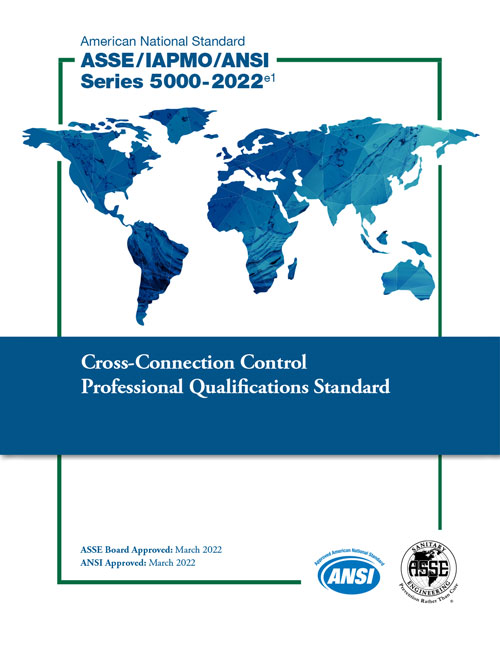
Four years later, ASSE introduced its first certification guidelines for cross-connection control professionals. Those initiatives laid the foundation for what would become ASSE’s extensive Professional Qualifications (PQ) standards program.
Today, ASSE’s PQ standards establish nationally recognized competency requirements that combine education, training, practical experience, and demonstrated proficiency. Developed through an ANSI-accredited consensus process, these standards provide a uniform underpinning for evaluating professionals whose work directly affects public health, safety, and building performance.
The scope of the PQ standards program extends across a diverse range of occupations. Professional qualifications standards currently address cross-connection control specialists, backflow prevention personnel, medical gas systems professionals, residential fire sprinkler installers and inspectors, self-contained breathing apparatus replenishment system personnel, firestop and smoke-limiting systems specialists, green plumbing system installers, water management and infection control professionals, service plumbers, residential mechanical service technicians, inspectors and plan examiners, rainwater harvesting professionals, water treatment equipment personnel, hybrid fire extinguishing system specialists, and inspectors of cured-in-place pipe rehabilitation projects.
While these professions represent different disciplines, they share the common objective of ensuring that critical building systems are designed, installed, operated, and maintained by competent individuals.
The importance of that objective cannot be overstated. Experience has repeatedly shown that failures affecting public health and safety are often not the result of defective products, but of mistakes made in installation, testing, inspection, maintenance, or operation.
By defining the knowledge, skills, and abilities necessary to perform specialized work, PQ standards help reduce those risks while supporting consistency across the industry. For practitioners, they create clear pathways for education, certification, career advancement, and ongoing professional development.
When viewed together, ASSE’s product standards and professional qualifications standards create a comprehensive framework for prevention. Product certification verifies that equipment has been designed, manufactured, and tested to meet established performance requirements. Professional certification verifies that the individuals responsible for applying that equipment have demonstrated the competence necessary to do so effectively.
Each reinforces the other.
When certified products are installed, inspected, tested, and maintained by certified professionals, the final link in the chain is secured and the loop is closed.
More than a century after Henry B. Davis gathered a small group of plumbing inspectors in Washington, D.C., ASSE continues to advance the same vision of protecting public health through standards, certification, and professional excellence.
This integrated approach reflects ASSE’s enduring motto: “Prevention Rather Than Cure.”
Prevention is not achieved solely through better products, nor solely through better training. It is achieved when both work together as part of a complete system of protection.

John Higdon
John Higdon, P.E., is director of Standards Development for ASSE International and IAPMO. Prior to joining IAPMO, he led the Engineering and Quality Assurance Departments of Merit Brass Company, Supply Source Products and Aalberts Industries. Higdon has served on ASSE’s Board of Directors as the manufacturers’ representative, served on numerous ASSE working groups, including as long-time chair of the backflow working group, and has served on ASSE’s Product Standards Committee, Code Committee, and Seal Control Board.
Last modified: November 13, 2026