
May 28, 2026

From the 2024 UPC Illustrated Training Manual, Chapter 5 – WATER HEATERS
509.6 Gas Vents. The installation of gas vents shall meet the following requirements:
(1) Gas vents shall be installed in accordance with the manufacturer’s installation instructions.
(2) A Type B-W gas vent shall have a listed capacity not less than that of the listed vented wall furnace to which it is connected.
(3) Gas vents installed within masonry chimneys shall be installed in accordance with the manufacturer’s installation instructions. Gas vents installed within masonry chimneys shall be identified with a permanent label installed at the point where the vent enters the chimney. The label shall contain the following language: “This gas vent is for appliances that burn gas. Do not connect to solid or liquid fuel–burning appliances or incinerators.”
(4) Screws, rivets, and other fasteners shall not penetrate the inner wall of double-wall gas vents, except at the transition from the appliance draft hood outlet, flue collar, or single-wall metal connector to a double-wall vent. [NFPA 54:12.7.2]
This section applies to gas vents of all types. Not included are chimneys, which are covered in Section 509.5, and single-wall metal pipe, which is covered in Section 509.7. A gas vent is defined as a listed factory-made vent pipe and fittings (see Section 224.0). Therefore, this section requires listed gas vents to be installed in accordance with the manufacturer’s installation instructions.
Type B and B-W gas vents that currently are listed are of double-wall construction: basically, a pipe within a pipe, with airspace between the two walls. This construction reduces the heat loss from the vent gases in much the same way that an insulated coffee mug works (see Figure 509.6a).
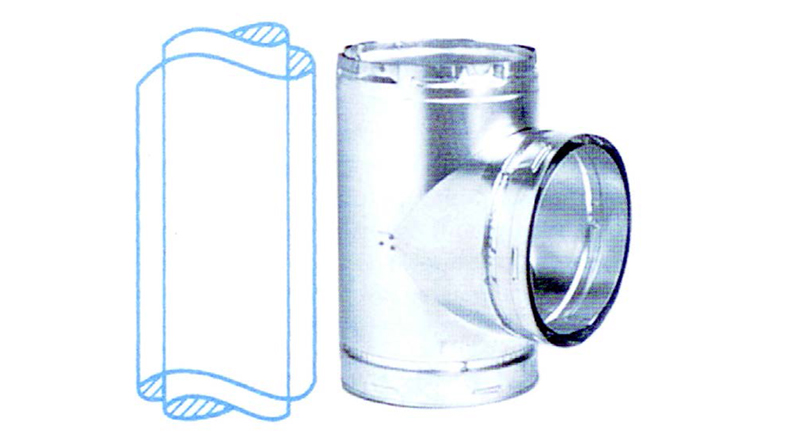
FIGURE 509.6A
CONSTRUCTION OF DOUBLE WALL TYPE B GAS VENT
Usually, the inner wall is made of aluminum to resist corrosion and the outer wall is made of galvanized steel for strength. The parts of the vent — pipe sections, supports, spacers, caps and flashings — are furnished for field erection to form a continuous passageway from the gas appliance to the terminus of the roof, including the cap or roof assembly. These parts are manufactured by several companies that furnish the vent pipe and other related parts needed to erect a complete vent. The piping and parts produced by the different manufacturers are not interchangeable without the use of special, listed adapters.
Type B gas vents can be round or oval (see Figure 509.6b).
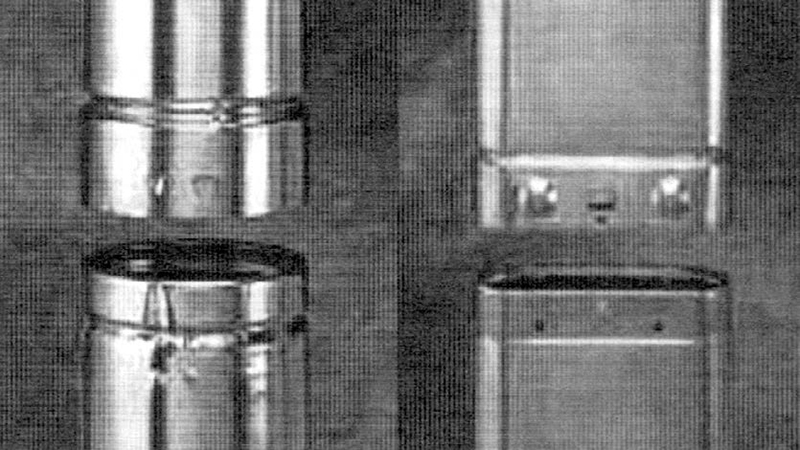
FIGURE 509.6B
TYPE B AND B-W DOUBLE WALL GAS VENT
Type B-W gas vents are always oval because they are designed to be installed within a stud space. Type L vents are similar in construction to Type B gas vents, except that the inner pipe of a Type L vent is stainless steel. Type L vents are intended for venting flue gases at higher temperatures than are normally produced by gas appliances, such as for oil furnaces listed for use with Type L vents. Typical Type B-W and B gas vent installations are diagrammed in Figures 509.6c and 509.6d, respectively.
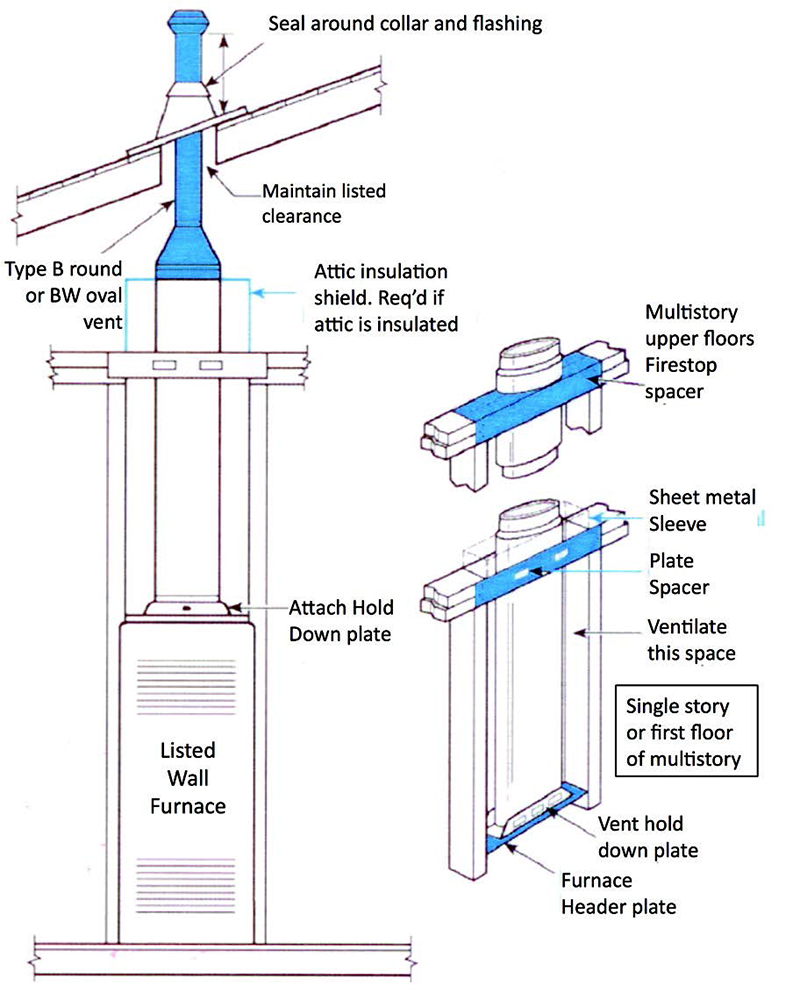
FIGURE 509.6C
TYPICAL TYPE B-W GAS VENT INSTALLATION
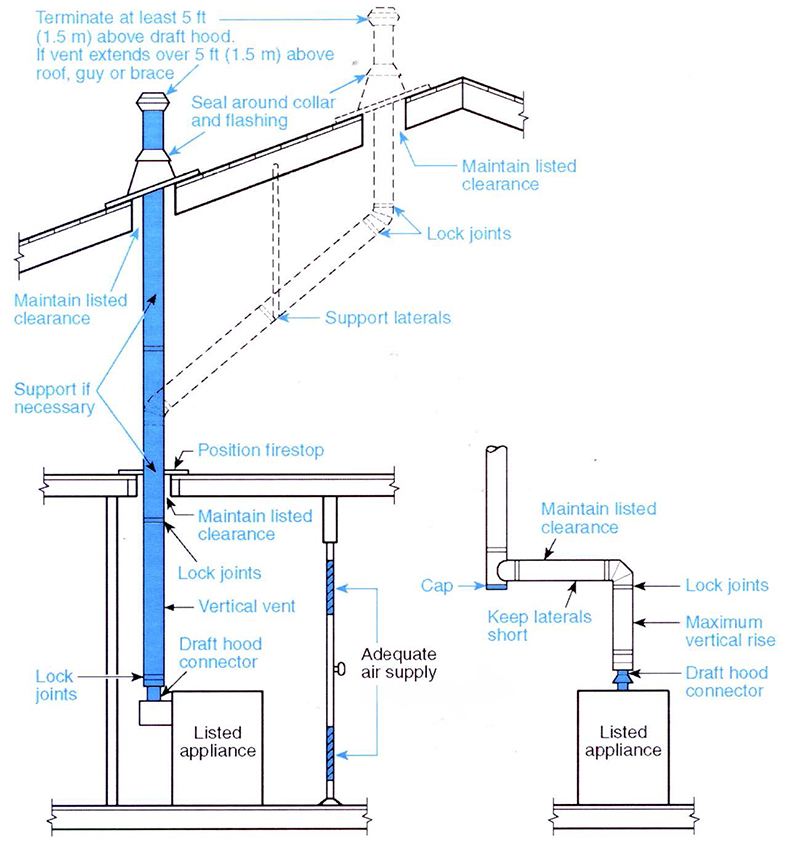
FIGURE 509.6D
TYPE B GAS VENT SINGLE APPLIANCE INSTALLATION
From the 2024 UMC Illustrated Training Manual, Chapter 5 – EXHAUST SYSTEMS
508.3.1 Grease Vapor. Wall-mounted exhaust hood assemblies shall be tight fitting against the back wall so as to not permit passage of grease vapor behind the hood, or between the back wall and the hood assembly. [NFPA 96:5.1.13]
Type I hoods require a 3-inch separation from limited combustible material. This air space is commonly built into the back of a hood. Hoods lacking this air space need to be flashed to the wall on the sides and bottom (see Figure 508.3.1).
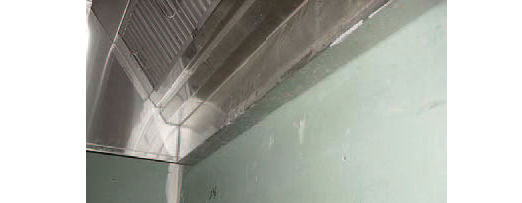
EXHAUST HOOD MOUNTING
(This is not to be considered the official position of IAPMO, nor is it an official interpretation of the Codes.)

IAPMO
IAPMO develops and publishes the Uniform Plumbing Code®,the most widely recognized code of practice used by the plumbing industry worldwide; Uniform Mechanical Code®; Uniform Swimming Pool, Spa and Hot Tub Code®; and Uniform Solar Energy, Hydronics and Geothermal Code™ — the only plumbing, mechanical, solar energy and swimming pool codes designated by ANSI as American National Standards — and the Water Efficiency Standard (WE-Stand)™. IAPMO works with government, contractors, labor force, and manufacturers to produce product standards, technical manuals, personnel certification/educational programs and additional resources in order to meet the ever-evolving demands of the industry in protecting public health and safety.
Last modified: May 28, 2026