
June 18, 2026

From the 2024 UPC Illustrated Training Manual, Chapter 3 – GENERAL REGULATIONS
312.8 Waterproofing of Openings. Joints at the roof around pipes, ducts, or other appurtenances shall be made watertight by the use of lead, copper, galvanized iron, or other approved flashings or flashing material. Exterior wall openings shall be made watertight. Counterflashing shall not restrict the required internal cross-sectional area of the vent.
One of the biggest drawbacks for multiple vents and for the placement of air-conditioning units, exhaust fans or other items on a roof is the possibility of water leakage around the openings through the roof. The requirements for flashing materials to be used and the opening to be watertight are specified in this section of the UPC. The AHJ may also require that the penetration be tested to prove its soundness.
Counterflashing is a style of vent flashing that can be used to seal the opening around a vent pipe. This flashing fits over the vent pipe and covers the opening in the roof, but it also sheaths the pipe up to and over the top of the pipe. Part of the flashing riser is then in the topmost interior of the vent. As will be seen in Chapter 9, there is a requirement for certain cross-sectional area dimensions for venting. The counterflashing in the interior of the vent pipe shall not restrict this dimension. For example, if a cross-sectional area of 3.14 square inches is required for aggregate venting and the interior dimension of a two-inch vent pipe would be reduced when utilizing a counterflashing, then the pipe size would have to be increased (see Figure 312.8).
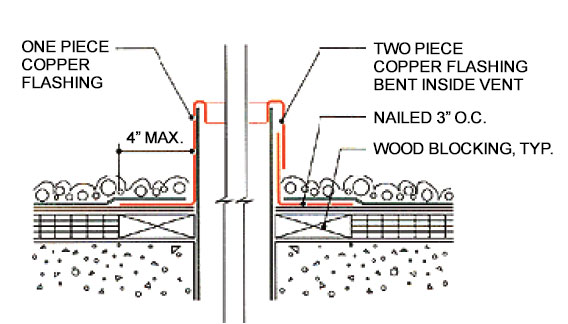
FIGURE 312.8
COUNTERFLASHING OF VENT PIPE
From the 2024 UMC Illustrated Training Manual, Chapter 7 – COMBUSTION AIR
701.12 Dampers Prohibited. Combustion air ducts or plenums shall not be installed so as to require openings in or penetrations through construction where fire dampers are required. Manually operated dampers shall not be installed in combustion air openings. With prior approval, power-actuated movable louvers admitting combustion air shall be permitted to be used and, where installed, shall be electrically interlocked with the main burner fuel-supply valve so as to prevent fuel delivery unless the louvers are in the fully open position.
Manual or fire dampers are prohibited from being installed on combustion air openings or ducts. The installation of combustion air ducts should avoid penetrating any fire-rated assembly, unless a rated shaft could be constructed around the combustion air duct to avoid the need for fire dampers. Motorized dampers are allowed provided there is assurance that they will open, and remain open, when the main burners of the appliance are operational. This section requires that the motorized damper be interlocked so the burners will not operate if the damper is closed and that they will shut down in the event the damper closes during the equipment operation. As mechanical devices installed on combustion air openings or ducts are subject to failure, this requirement will provide the necessary assurance that the appliance will not operate unless combustion air is made available.
(This is not to be considered the official position of IAPMO, nor is it an official interpretation of the Codes.)

IAPMO
IAPMO develops and publishes the Uniform Plumbing Code®,the most widely recognized code of practice used by the plumbing industry worldwide; Uniform Mechanical Code®; Uniform Swimming Pool, Spa and Hot Tub Code®; and Uniform Solar Energy, Hydronics and Geothermal Code™ — the only plumbing, mechanical, solar energy and swimming pool codes designated by ANSI as American National Standards — and the Water Efficiency Standard (WE-Stand)™. IAPMO works with government, contractors, labor force, and manufacturers to produce product standards, technical manuals, personnel certification/educational programs and additional resources in order to meet the ever-evolving demands of the industry in protecting public health and safety.
Last modified: June 18, 2026