June 11, 2026
From the 2024 UPC Illustrated Training Manual, Chapter 6 – WATER SUPPLY AND DISTRIBUTION
603.3.5 Pressure Vacuum Breaker Backflow Prevention Assembly (PVB). A pressure vacuum breaker backflow prevention assembly consists of a loaded air inlet valve, an internally loaded check valve, two properly located test cocks, and two isolation valves. This device shall be permitted to be installed indoors where provisions for spillage are provided.
The pressure type vacuum breaker (PVB) evolved from the AVB. There are a number of AVB installation restrictions due to the limits of the design. One of the AVB’s limitations is the restriction of no continuous water pressure. The concern of the inlet valve sticking closed is serious, as it would render the AVB useless. The PVB was designed to overcome this problem.
The AVB has one moving part that works as an air inlet or port and it serves as a check valve to the supply piping when no water pressure is present. The PVB check valve is similar but spring loaded. When the piping-system pressure is reduced, the spring forces the check open to the atmosphere, allowing air into the system and breaking the downstream siphon.
PVBs, therefore, are designed to operate under pressure for long periods of time without becoming inoperative. The internal check valves are spring-loaded so that any tendency for the valve to stick closed due to long periods of applied pressure and consequent fouling will be counteracted.
The continuous pressure restriction would no longer apply and would allow valves downstream and water pressure 24 hours per day. This type of assembly may be used only where outlet pressure will never exceed inlet pressure and is not subject to backpressure. This device may be installed indoors only if provisions for spillage from the dome are provided. They must be installed a minimum of 12 inches above the highest piping downstream of the PVB (see Figure 603.3.5).
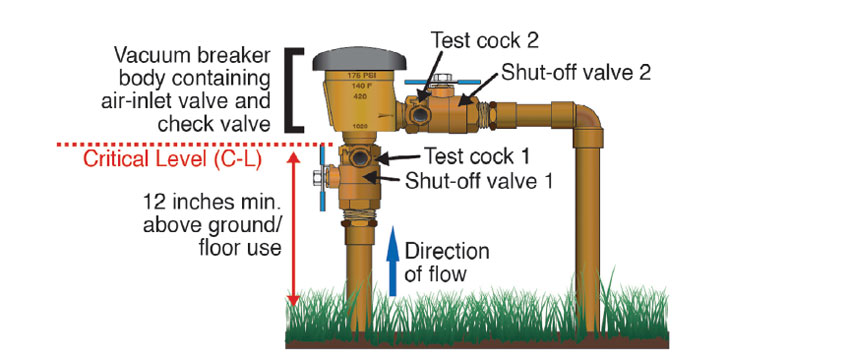
PRESSURE VACUUM BREAKER BACKFLOW PREVENTION ASSEMBLY INSTALLATION
From the 2024 UMC Illustrated Training Manual, Chapter 6 – DUCT SYSTEMS
602.1 General. Materials used for duct systems shall comply with Section 602.2 through Section 602.7 as applicable.
Concealed building spaces or independent construction within buildings shall be permitted to be used as ducts or plenums. Gypsum board shall not be used for positive pressure ducts.
Exception: In healthcare facilities, concealed spaces shall not be permitted to be used as ducts or plenums.
SMACNA reflects the current industry practices in duct construction. The Sheet Metal and Air Conditioning Contractors National Association (SMACNA) has developed the Duct Construction Standards for supply air, return air, and outside air for heating, cooling, or evaporative cooling systems. Shop drawings should be submitted when using the standard HVAC duct construction because of the wide variety of options available.
Concealed spaces are not to be used as ducts; however, duct materials complying with Chapter 6 as well as constructed and sealed in compliance with SMACNA duct construction standards may be installed in a building cavity.
Figure 602.1 illustrates a panned joist space that could be used. The required flame spread and smoke-developed rating stipulated in Section 602.2 would preclude this construction in uses other than dwelling units (see Exception 1).
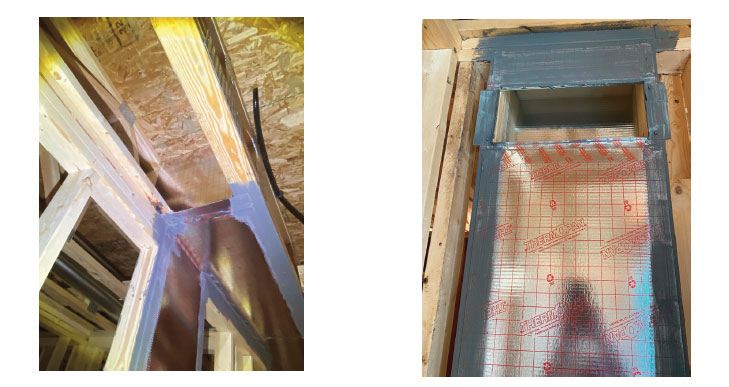
PANNED JOIST SPACE
(This is not to be considered the official position of IAPMO, nor is it an official interpretation of the Codes.)
IAPMO
IAPMO develops and publishes the Uniform Plumbing Code®,the most widely recognized code of practice used by the plumbing industry worldwide; Uniform Mechanical Code®; Uniform Swimming Pool, Spa and Hot Tub Code®; and Uniform Solar Energy, Hydronics and Geothermal Code™ — the only plumbing, mechanical, solar energy and swimming pool codes designated by ANSI as American National Standards — and the Water Efficiency Standard (WE-Stand)™. IAPMO works with government, contractors, labor force, and manufacturers to produce product standards, technical manuals, personnel certification/educational programs and additional resources in order to meet the ever-evolving demands of the industry in protecting public health and safety.
Last modified: June 10, 2026