
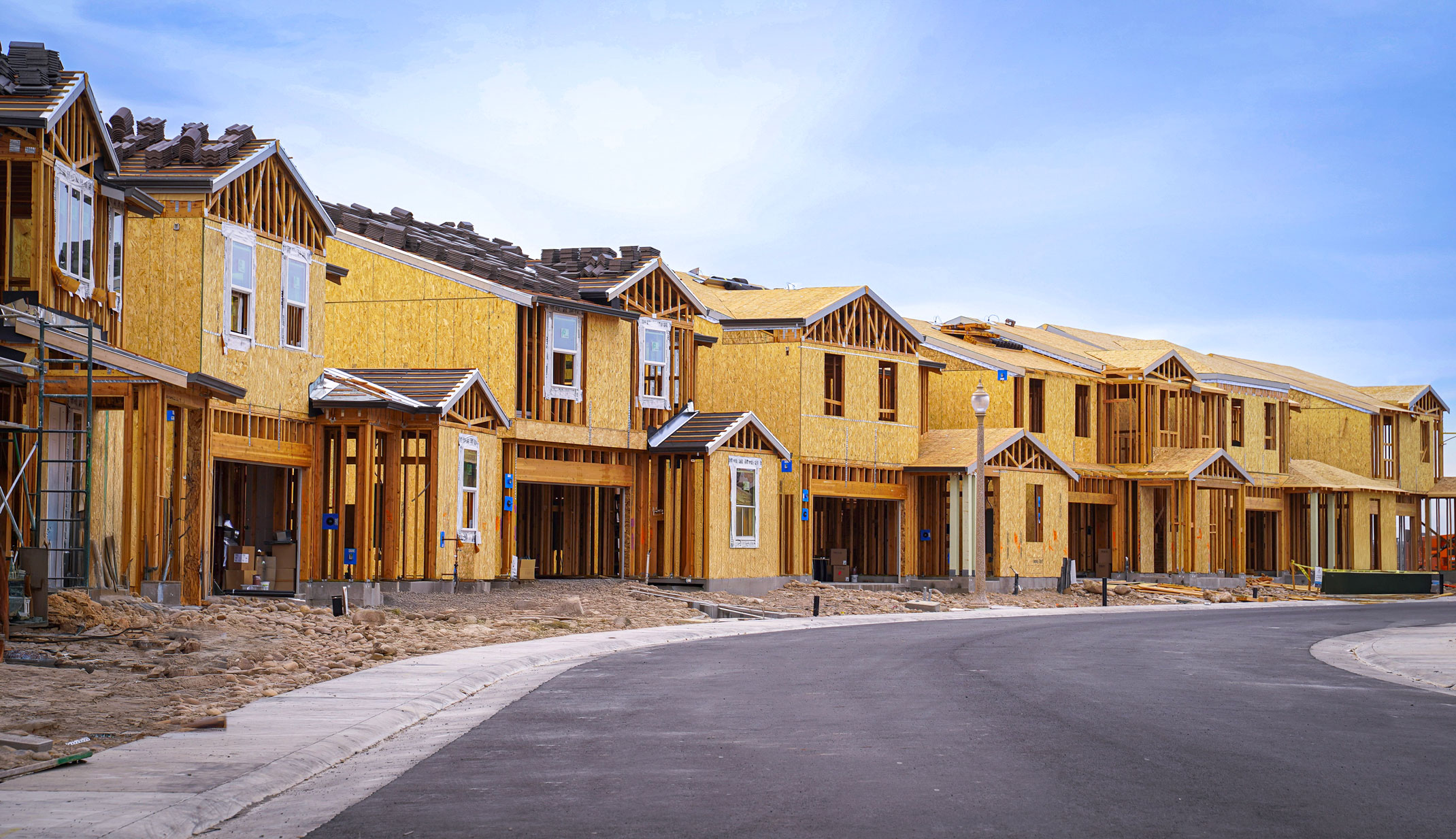
PLUMBING AND ENERGY SYSTEMS EXPERT CALLS FOR SHIFT IN APPROACH
When discussing resilience in buildings, the conversation often centers on reliability — systems that work 99% of the time. For Gary Klein, a plumbing and energy systems expert, that’s not enough.
“We are confusing the reliability of systems with the resilience of them,” he said. “Our plumbing, electrical and gas grids are all expected to maintain a fairly high percent reliability. Resilience is what happens when that fails.”
To shift the way people think about resilience, Klein often starts with a scenario: “If all of your utilities that come to your house fail — and I mean all of them — how many hours can you stay in your house?” For most homes, he said, the answer is not very long.
“You now have to build an outhouse, he said. “And that will happen within a day.”
Designing for Climate Extremes
Many of today’s building codes and sizing rules are based on historical climate data and predictable demand, but climate patterns are no longer predictable.
“Storms are getting stormier,” he said. “Droughts are getting droughtier. High temperatures are getting higher. Low temperatures are getting lower.”
He emphasized that while average temperatures or rainfall haven’t changed dramatically, the variance has increased.
“Normal isn’t normal anymore,” he said. “The variations around the mean have gotten bigger for almost everything we care about for reliability.”
That variability makes location-specific design even more important.
“If you build below 80 feet above sea level, you probably ought to think about stilts,” he said. “If your community periodically floods, you should think about stilts. Why? It’s going to get worse, not better.”
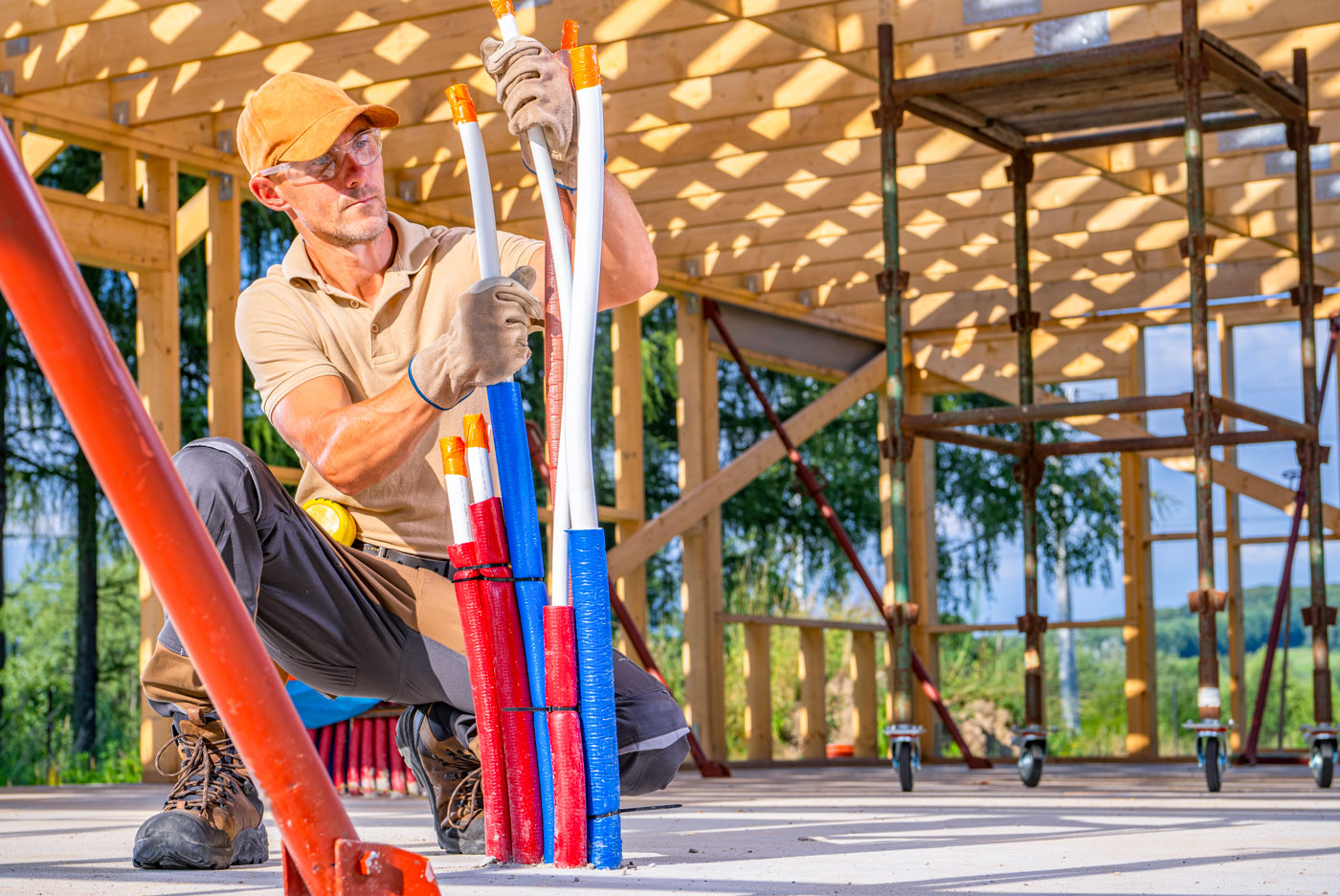
A plumber installs and organizes colorcoded PEX piping at a residential construction site, preparing the system for water distribution. GETTY IMAGES
Smarter Materials And Guidelines
Whether the hazard is fire, flood, or drought, resilience starts with material selection and site design.
“We should be picking roofs and construction of roofs to minimize the risk of fire damage — pretty much everywhere,” Klein said. He also warned that outdated aesthetic rules can increase risk: “Subdivisions have HOAs that require you to put plants that’ll burn right next to your house —not smart.”
Thoughtful layout and design also play a major role in eliminating hidden inefficiencies that compromise affordability and resilience. Klein has spent years studying how buildings unintentionally waste water and energy — and how smarter design can fix that. A key example: long hot water distribution lines. “We have long runs from the water heater to plumbing fixtures,” he said. “And if you want hot water, it takes roughly two times the amount of water that’s in a pipe before water hot enough to shower in comes out the other end.”
He once measured 4 gallons and four minutes before hot water reached a shower with a 1-gallon-per-minute head.
“There were 2 gallons of cold water sitting in the hot water branch pipe when I turned on the tap,” he said. “That’s a structural waste we built into the building.”
The key, he said, is to design and construct buildings that minimize unintended or unnecessary waste.
Because they tend to be the most expensive rooms in the building, Klein said it is much less expensive to construct buildings in which wet rooms are close to the water heaters that serve them, and to have a hot water system footprint that is as small as possible.
He recalled a conversation he had with a Habitat for Humanity builder in California who, over the span of several years, was able to drastically reduce the footprint from the widely practiced average of 80% to less than 1%.
“Two bathrooms, a laundry room and a kitchen; 1% of the floor area or less is related to the hot water system,” Klein said. “I think he cracked the problem. That’s what we want to promote.”
Passive Resilience
Klein was an inaugural member of IAPMO’s Green Technical Committee as it worked toward the development of the Green Plumbing and Mechanical Code Supplement — now the Water Efficiency and Sanitation Standard (WE•Stand) — and was named IAPMO’s Joseph Kneidinger Sustainability Professional of the Year in 2014. A profilic writer and public speaker, he also has worked with such organizations as ASHRAE, LEED and the National Green Building Standard.
Klein knows resilient buildings are possible because he helped design and build one more than four decades ago.
In 1981, he worked on a 1,000-squarefoot home in Africa that has never needed mechanical heating or cooling.
“We designed it to never need heating and cooling that was mechanical,” he said, “and by definition, it had to be comfortable.” The bricks for the home were made from clay dug out of the site, and the home included rainwater catchment and graywater separation.
“That house has never had mechanical heating or cooling. That’s over 45 years now.”
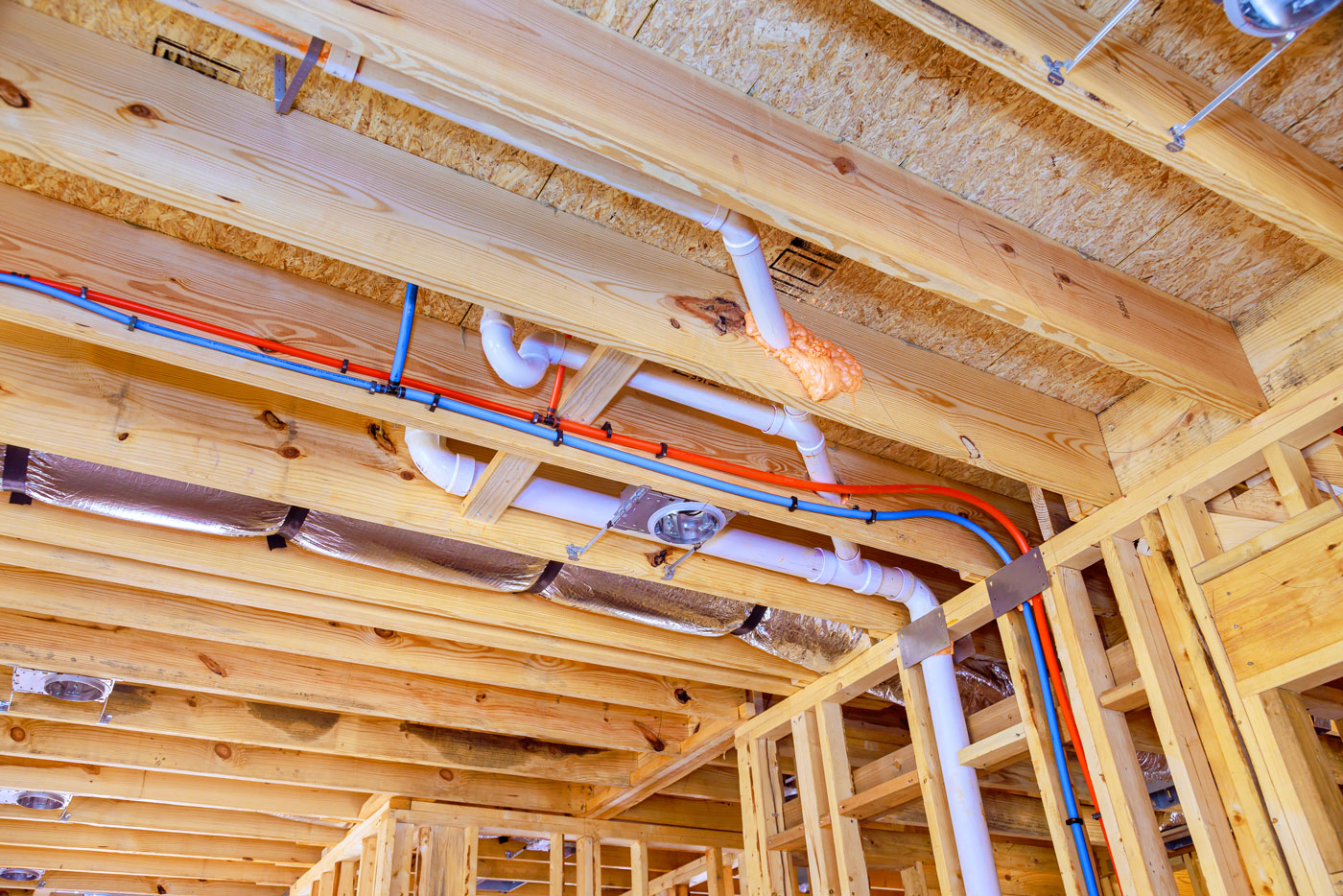
PEX water supply lines and PVC drain piping installed through exposed framing, showing rough-in plumbing during residential construction. GETTY IMAGES
Resiliency through Conservation
In drought-prone areas, conserving water is among the best paths to achieving resiliency.
“Setting up your buildings to use the least amount of water possible makes it easier to go through droughts,” Klein said. “If we want to be smart about it, we build in infrastructure to waste as little as possible.”
While smart leak detection systems are valuable — and increasingly recognized by insurers — Klein believes physical design is even more effective.
In 2008, while traveling in Australia with his wife and daughter, Klein noticed a consistent feature in every home in which they stayed: wet rooms were built an inch lower than the rest of the house and had visible drains.
“If you have a central floor drain for every wet room and something in the wet room leaks, the water will go down the drain to protect the building,” he said. “It’s an insurance policy. I don’t need a leak detection device; I need a big drain to absorb a big overflow of water. There are no moving parts; it’ll work.”
Klein referenced a home built by Larry Chauvin in Baton Rouge — a project on which he consulted and which was later featured on Matt Risinger’s “Build Show Network.”
The home featured an unconventional plumbing design, including the decision to eliminate almost all hose bibs from the exterior walls — Klein said there may be one or two for the outdoor kitchen. Instead, irrigation lines were kept entirely within the yard, separate from the home’s internal plumbing. This approach helped isolate the irrigation system from pressure changes in the house and eliminated unnecessary piping routes, improving overall efficiency and reducing risk.
Additionally, the home’s mechanical room was placed in the attic due to its central location. To prepare for when the water heater inevitably fails, they designed the room as a large “wet room,” complete with tiled walls, a sloped floor, and a 3- or 4-inch floor drain to handle water overflow. The municipal water line enters through a conduit beneath the house and feeds directly into this attic space, where all the home’s valves are centralized. The result is a more resilient and maintainable plumbing system, designed to limit damage and simplify response during system failures.
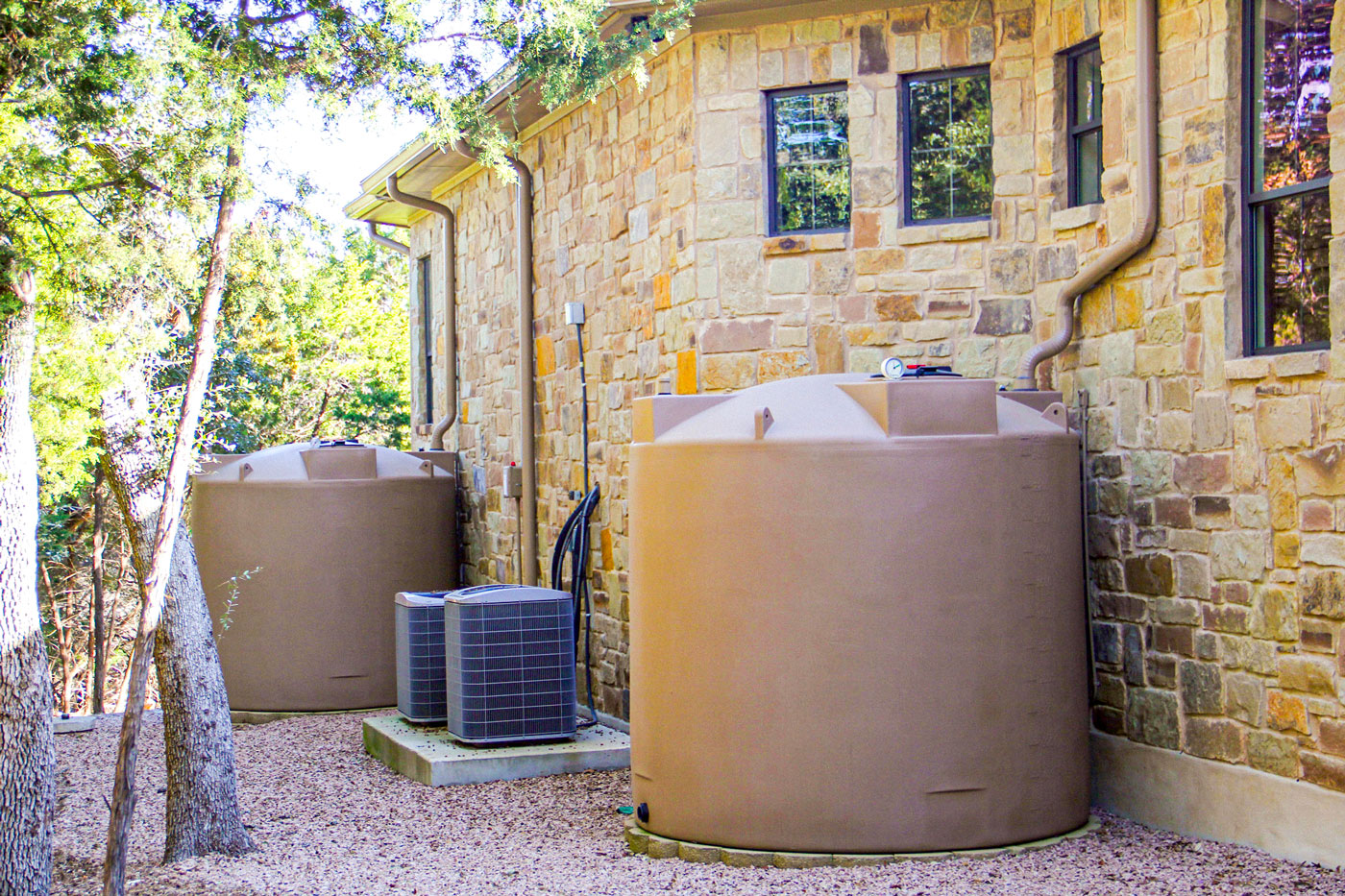
Making Rainwater Systems Primary
To Klein, rainwater harvesting systems should be treated as core infrastructure — not just green add-ons.
“We should be designing catchment systems to serve as surge tanks during storms and as reliable water sources during drought,” he said. “That’s not supplemental — it’s foundational.”
He pointed to Texas builder Darrel McMaster, who has constructed more than 100 homes that rely entirely on rainwater. Each is equipped with tanks ranging from 20,000 to 50,000 gallons, and the systems begin collecting water as soon as the roof is installed — ensuring months of supply even before the home is complete.
“No failures. No losses. Nobody ran dry,” he said. While preparing simply for average rainfall might seem adequate, the wide variability in weather patterns demands storage systems that can accommodate abundance and scarcity.
“That’s why you design storage,” he said.
Ahead of Its Time
Klein also highlighted the work of Chicago-based landscape architect Marcus de la Fleur, who redesigned a house that was built in the 1920s.
“It had a carriage house, an outhouse and rainwater catchment when it was built,” he said. “And he renovated the rainwater catchment system and reconfigured the landscape so that during a 99-percentile rain event, no water made it to the street. Best I know of in the country.”
Beyond Reliability
For Klein, resilience isn’t about keeping things running 99% of the time — it’s about what happens when everything stops. True resilience, he says, means designing buildings that can still function when the power’s out, the water’s off, and the usual systems fail. It’s about planning ahead, minimizing waste, and making smart choices that keep people safe and comfortable in uncertain conditions. Whether through compact plumbing layouts, passive design, or rainwater systems built to carry real load, Klein’s definition of resilience is rooted in self-sufficiency — and in the belief that we can, and should, build for what might go wrong, not just what usually goes right.

Mike Flenniken
Mike Flenniken is a staff writer, Marketing and Communications, for IAPMO. Prior to joining IAPMO in 2010, Flenniken worked in public relations for a group of Southern California hospitals and as a journalist in writing and editing capacities for various Southern California daily newspapers.
Last modified: April 29, 2026