
Innovation in plumbing and mechanical systems rarely arrives all at once. Change occurs in steady waves: new products, new materials, smarter controls, and more efficient systems. Each wave creates opportunities for progress, but it also raises important questions. Does this technology perform reliably? Is the product safe? Can it be installed and maintained consistently? How can regulators and the industry evaluate it uniformly everywhere?
That’s where standards come in.
At IAPMO, standards are viewed as living documents designed to evolve alongside the technologies shaping the built environment. This approach supports the broader mission of paving the path to a safer and healthier built environment while ensuring innovation can move forward with both clarity and confidence.
Why Adapting Matters
Standards may often be described as “rules,” but effective standards do more than just set minimum requirements for the product or personnel. They help align an entire ecosystem of manufacturers, installers, inspectors, engineers, utilities, and authorities having jurisdiction around shared expectations for both performance and safety.
As technology changes, these expectations must keep pace. Adapting standards helps the industry by:
- protecting public health, safety, and welfare as new products and systems enter the market.
- encouraging innovation by giving manufacturers a clear pathway to demonstrate product performance and build credibility.
- improving consistency, so products, people, and systems are evaluated using repeatable criteria rather than guesswork.
In other words, standards are not barriers to progress, rather they are the bridge that allows progress to scale responsibly.
How New Technologies Become Standards
Standards are not written behind closed doors in isolation. Instead, they are shaped by the people who are closest to the work themselves. At IAPMO, industry volunteers, in conjunction with professional internal staff, periodically review and update standards to keep pace with technological changes.
The process often begins when a need for change is identified. The need may come from a new product entering the marketplace, advancements in materials or system design, lessons learned from field experience, or gaps that were uncovered during enforcement or inspection. In some cases, it becomes clear that an entirely new standard is needed; in others, existing language simply needs to be clarified, expanded, or revised.
Once a need is identified, IAPMO convenes a technical subcommittee or working group. These committees are made up of volunteers from across the industry, be it manufacturers, installers, inspectors, engineers, researchers, regulators, or consumers. Their role is to work collaboratively on drafting language that reflects the current technology while defining clear technical requirements focused on public health, performance, and safety. Participation in these technical groups is voluntary and open to interested individuals.
From this point, work becomes iterative. Drafts are developed, revised, and refined as comments and objections are addressed. Each step is documented and committee decisions are communicated transparently as the draft evolves. For national standards, this work takes place within established consensus frameworks, such as the ANSI essential requirements. Frameworks such as these ensure balance, due process, and broad stakeholder review. The result is a standard that doesn’t just reflect what is new, but what has been carefully examined, discussed, and validated by the industry.
What This Looks Like in Practice
Without standards, innovation struggles to move beyond early adoption. Products may exist, but uncertainty about performance, safety, and enforcement limits their ability to scale. Standards are what turn innovation into infrastructure.
One example is combined handwashing systems, which integrate a faucet, soap dispenser, and hand dryer into a single unit. As these systems became more common in public and commercial spaces, they did not align neatly with standards written for individual components. That gap created inconsistency for regulators and uncertainty for manufacturers. Through the development of IAPMO/ANSI Z1404, Combined Handwashing Systems, industry volunteers established clear performance and safety criteria, allowing these products to be evaluated consistently across jurisdictions.
Standards also evolve when innovation changes how systems are designed, not just how products perform. As water-efficient fixtures became widespread, long-standing pipe sizing assumptions no longer reflected actual water use. Research demonstrated that oversized systems increased costs and could negatively affect water quality. This work informed IAPMO/ANSI/CAN Z1403, Water Demand Calculator®, which aligns design methodologies with modern usage patterns. The result is clearer guidance for designers and regulators, more efficient systems, and better use of materials and water resources.
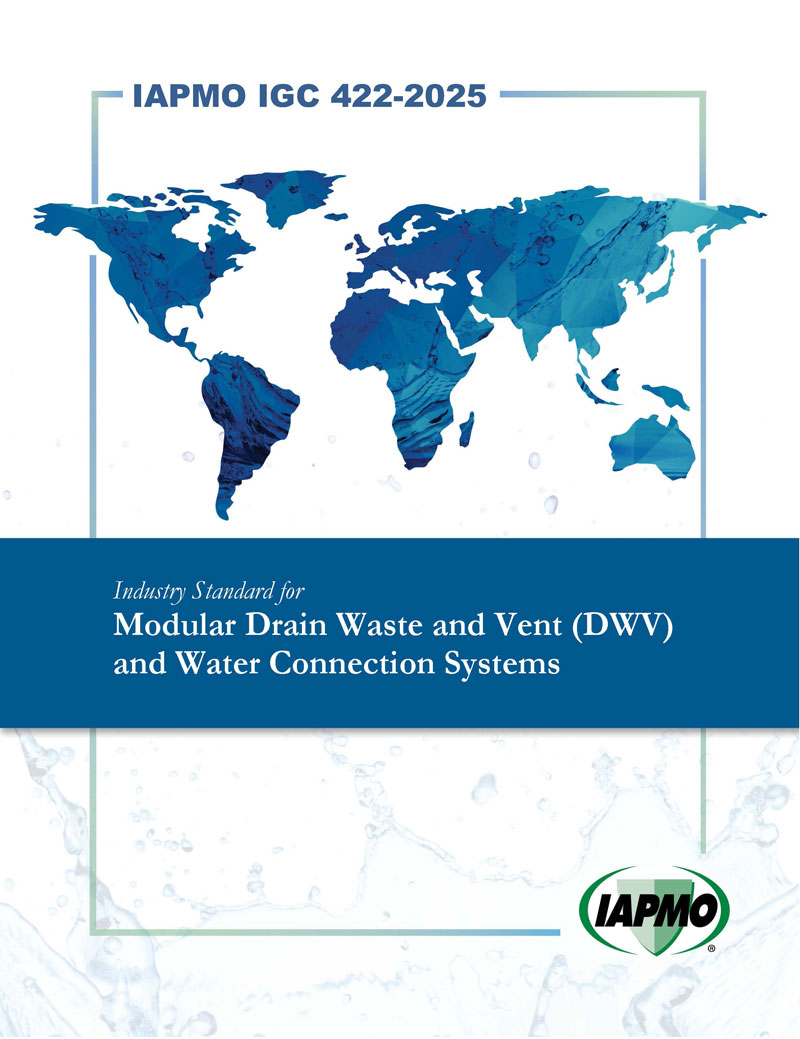
In other cases, innovation first appears as an entirely new product category. Modular drain, waste, and vent (DWV) and water connection systems are one such example and are increasingly used in prefabricated and modular construction applications. These products challenged traditional installation assumptions and were not fully addressed by existing standards.
Through IAPMO IGC 422, Modular DWV and Water Connection Systems, performance based criteria were developed to address safety, reliability, and consistency. This demonstrates how IAPMO IGCs can provide a practical pathway for emerging technologies while the market continues to evolve.
Across each of these examples, the outcome is the same. By responding to real-world innovation with clear, consensus based requirements, standards help new technologies move from uncertain to widely accepted, supporting safety, consistency, and confidence across the industry.
A Living Document Mindset: Continuous Improvement
Even when a standard is published, the work is not complete. Many standards are maintained through ongoing review cycles, ensuring that the document continues to reflect modern technologies, current best practices, and lessons learned following the implementation of the standard itself. This is part of a healthy standard ecosystem. A strong standard shall remain stable where it must, and flexible where it should. In doing so, standards protect the public while supporting industry growth without becoming outdated as innovation accelerates.
Collaboration is How Standards Stay Relevant
There is not a single organization, manufacturer, or stakeholder group that has a complete view of what the future will bring. This is why collaboration is essential. Through structured technical work, such as drafting and revision support that is provided by each technical sub-committee or working group, new ideas can be evaluated carefully, and improvements can be incorporated responsibly.
Additionally, public participation remains part of the process. All IAPMO standards and their related updates are subject to a public review period. This activity helps ensure stakeholders can engage, comment, and contribute to outcomes that impact the industry and communities it serves.
Looking Ahead and How You Can Get Involved
Technology will continue to evolve, sometimes faster than we expect it to. But the IAPMO standards community is built for this reality. Combining due process, transparent collaboration, and a commitment to public health and safety helps ensure that the next wave of innovation becomes the next generation of reliable, trusted practice.
If you’re developing, installing, enforcing, researching, or simply using emerging technologies, consider lending your voice to the standards process. You can participate by reviewing drafts during a public review period or by getting involved in open standards projects. Information on open projects is available through the IAPMO website, or you can reach the team at standards@iapmostandards.org to learn more.

Manager of Standards Development at IAPMO | ANSI & SCC Standards Governance | Plumbing & Mechanical Systems | Demystifying Standards
Last modified: April 15, 2026