
As IAPMO marks its 100th anniversary, its international presence stands as one of the clearest reflections of how far the organization’s public health mission has reached. What began as a model plumbing code developed for jurisdictions in the United States has, over time, evolved into a global framework for collaboration — one rooted not in simple export, but in partnership. Across continents, IAPMO’s growth has depended on local leaders, national standards bodies, professional societies, and multilateral organizations working together to adapt plumbing standards to local needs.
Again and again, the lesson has been the same: meaningful progress happens when local expertise meets global experience. Whether through national standardization agencies, professional engineering societies, or international health bodies, IAPMO’s role has been to support — not supplant — local leadership. The result has been a model of “global reach, local impact,” where plumbing codes, training, testing, and certification systems are built collaboratively and tailored to the communities they serve.
Early International Code Efforts: Vietnam, Jordan, and Kuwait
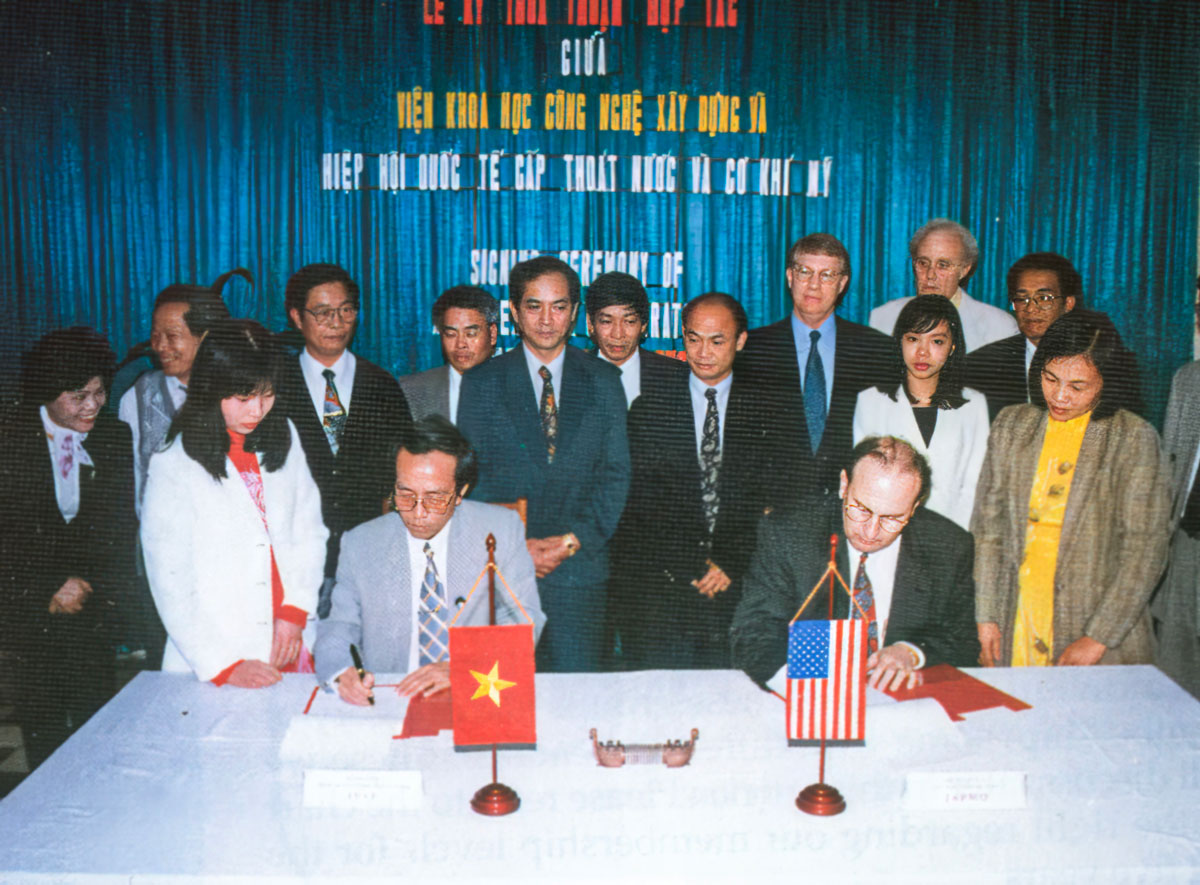
IAPMO’s earliest international code initiatives date back to the mid-1990s. Among the first was work in Vietnam (1996–97), where, with support from U.S. government contacts, IAPMO assisted in introducing and teaching the Uniform Plumbing Code (UPC®). Roger Courtney traveled to Vietnam to help train stake-holders on the code’s application. Similar efforts followed in the Kingdom of Jordan, representing IAPMO’s first forays into adapting its code for use beyond U.S. borders. In 2007, IAPMO collaborated with the Water Research Division of Kuwait’s Ministry of Electricity and Water to develop the Uniform Potable Water Plumbing Code of Kuwait.
Unlike earlier efforts, this project focused specifically on potable water systems and was developed in close coordination with a national government ministry. While these early initiatives were more limited in scope than later international programs, they laid important groundwork. They demonstrated both the global need for modern plumbing standards and the importance of working through formal partnerships and government channels.
India
IAPMO’s collaboration in India represents one of its most comprehensive and enduring international partnerships. The relationship began through shared leadership within the World Plumbing Council, where IAPMO CEO Russ Chaney developed a strong professional connection with Sudhakaran Nair, then president of the Indian Plumbing Association (IPA). From that relationship grew a partnership that would become a model for future international expansion.
Rather than simply exporting the UPC, IAPMO and the IPA established a technical committee in India to review the code line by line. This process — described as “indigenization” — ensured that the resulting documents reflected India’s climate, construction practices, and regulatory landscape. This collaboration produced the Uniform Plumbing Code of India, the Uniform Mechanical Code of India, the Uniform Swimming Pool, Spa and Hot Tub Code of India, the Uniform Solar, Hydronics and Geothermal Code of India and the Water Efficiency and Sanitation Standard of India. To streamline education and training, IAPMO and IPA ultimately combined code text and illustrated training materials into the Uniform Illustrated Plumbing Code of India.
The partnership expanded beyond code development. Education-to-employment programs such as Plumbing Education to Employment (PEEP) and Mechanical Education to Employment (MEEP) supported workforce development. IAPMO also introduced the Water Efficient Products– India (WEPI) specification to certify waterefficient plumbing products.
Over time, the collaboration led to the establishment of an in-country IAPMO office and laboratory, enabling local testing and product certification services.
Central to this growth has been the IPA itself — now one of the largest plumbing organizations in the world. With tens of thousands of members spanning engineers, contractors, and manufacturers, the IPA has provided both technical leadership and trusted local guidance. Together, IAPMO and the IPA built not just codes, but an ecosystem of standards, training, and certification aligned with India’s needs.
Indonesia
Indonesia’s partnership began with a rediscovery. During an ISO witness audit in the early 2010s, IAPMO revisited an earlier memorandum of understanding (MOU) that existed between IAPMO and Badan Standardisasi Nasional (BSN), Indonesia’s National Standardization Agency. That connection was renewed, and in 2013 BSN representatives visited IAPMO’s headquarters, launching a revitalized collaboration.
A new MOU clarified scope and intent, and in 2014 a joint technical committee was formed. By 2015, Indonesia’s plumbing standard, SNI 8513:2015, Plumbing Systems for Buildings — adapted from the UPC — was formally published. As in India, the code was carefully tailored to local conditions. Requirements irrelevant to Indonesia’s climate were removed, while cultural and religious practices, such as the accommodation of squat toilets and ablution fixtures, were incorporated.
BSN, then under the leadership of Chair Prof. Dr. Bambang Prasetya, emphasized that standards require infrastructure to be effective. In response, IAPMO established a laboratory in Indonesia in 2016, providing in-country product testing and certification. By 2017, as manufacturers began engaging with the program, the Indonesian Plumbing Association was formed to support industry development. What began as a standards project evolved into a full-service presence, supported by strong cooperation with BSN and other government stakeholders. Through its extensive standards development, training, and capacity-building work in Indonesia, IAPMO strengthened international trade opportunities for U.S. manufacturers — efforts that culminated in the association receiving the President’s “E” Award and later the President’s “E Star” Award for sustained excellence in export promotion.
Australia
IAPMO’s expansion into Australia — operating as IAPMO Oceania — reflects its consistent model of building lasting partnerships within established regulatory frameworks. A key element of that growth has been its close relationship with the Plumbing Industry Climate Action Centre (PICAC), where collaboration on industry engagement has strengthened ties between certification, workforce development, and on-the-ground practice. Through these partnerships, IAPMO has positioned itself not as an outside authority, but as a contributing participant within Australia’s mature plumbing and gas regulatory environment.
Similar to the relationship formed with the IPA leadership, Chaney developed a strong working relationship with Shayne LaCombre, CEO of PICAC, as a result of their service together on the World Plumbing Council executive board. A mutual respect for each other’s organizations and similar missions led to where things stand today — shared office space in Melbourne, in a net-zero facility. This is a far leap from IAPMO’s first days in Australia, when Quality Manager Glenn Tate was the only staff member, operating out of a small business office. Back then, Stuart Henry — past WPC chair, former WPC secretariat, and current consultant for IAPMO — helped establish IAPMO’s emergence into this new market.
Managing Director Paul Bonsak and the expert Australian staff members have played instrumental roles in aligning IAPMO’s international conformity assessment expertise with Australia’s WaterMark and GasMark product certification schemes. By supporting both frameworks — which govern plumbing and gas products nationally — IAPMO Oceania has helped provide manufacturers with credible, locally recognized pathways to compliance while connecting them to IAPMO’s broader global network. Today, the Oceania office also supports IWSH Australia as IAPMO works together with PICAC and other industry partners to give back to the local community.
Mexico
IAPMO’s expansion into Mexico represents a significant chapter in its broader international growth strategy, combining regulatory partnership, technical investment and long-term market engagement. In 2023, IAPMO opened IAPMO Mexico, a state-ofthe- art laboratory in Monterrey, initially equipped to test toilets to NOM-002- CONAGUA-2021 requirements and later expanding capabilities to meet the nation’s updated standards. The lab was established in direct response to requests from manufacturers and regulators seeking local, accredited testing services that could reduce time to market while strengthening compliance with Mexico’s mandatory product standards.
The effort culminated in 2025 with IAPMO R&T Lab’s approval to conduct testing in the United States to NOM-012-CONAGUA-2021, Mexico’s comprehensive new standard governing faucets, valves and fittings for drinking water. The standard introduces enhanced requirements for low lead content, durability, performance and water efficiency, reflecting Mexico’s national focus on potable water quality and conservation. Through close collaboration with CONAGUA and active participation in standards development, IAPMO positioned itself as both a technical resource and trusted partner in advancing product safety. Together, the Monterrey laboratory and expanded cross-border testing capabilities illustrate IAPMO’s model of international expansion: investing locally, aligning with national regulatory priorities, and reinforcing public health protections through accredited certification systems.
World Health Organization
IAPMO’s relationship with the World Health Organization (WHO) has developed through its leadership and support roles within the World Plumbing Council (WPC), a nongovernmental organization formally recognized by WHO. Serving in a liaison capacity on behalf of the WPC, IAPMO has provided technical expertise to WHO initiatives and guidance documents addressing water distribution and sanitation systems.
One early milestone was collaboration on the landmark Health Aspects of Plumbing publication in the late 1990s. In subsequent years, IAPMO representatives have participated in WHO working groups developing guidance on water distribution and sanitation systems. While the formal NGO relationship exists between WHO and the World Plumbing Council, IAPMO has often served as the technical facilitator and representative for the plumbing industry, helping ensure that plumbing expertise informs global public health policy.
Rwanda
Rwanda’s story illustrates how investment in individual leadership can catalyze national change. Plumber Jean Claude Twagirimana first connected with the global plumbing community through a World Plumbing Council scholarship supported by industry partners. After traveling to the United States for instructor training with the United Association, he returned home inspired to elevate plumbing standards in Rwanda.
Twagirimana founded the Rwanda Plumbers Organization (RPO), building momentum among local professionals. With donated codes, training support, and collaboration from IAPMO and industry volunteers, RPO began working with the Rwanda Standards Board to develop a Rwanda Plumbing Code based on the UPC. The ongoing effort has underscored the importance of building a complete ecosystem — standards, training, inspection, and government engagement — to create lasting public health impact. As this article goes to print, development of the Rwanda Plumbing Code is in the final stages.
The Philippines
In the Philippines, IAPMO partnered with the Philippine Society of Sanitary Engineers (PSSE) to develop multiple editions of the Uniform Plumbing Code of the Philippines. PSSE established a technical committee to review and adapt the UPC to Philippine conditions, creating a strong professional foundation for plumbing standards.
Two leaders have played particularly important roles. Ascension “Bong” Fonte, then president of PSSE, signed the original memorandum of understanding formalizing the partnership. Later, Bonifacio “Boni” Magtibay — also a sanitary engineer and former PSSE president — became a key figure in advancing collaboration. Magtibay’s concurrent leadership role within the WHO Philippines Country Office further strengthened ties between professional, governmental, and international health stakeholders.
While complexities remain within the Philippine plumbing landscape, ongoing efforts aim to bring together professional organizations such as PSSE and the National Master Plumbers Association of the Philippines (NAMPAP) in support of modernized standards. Recent WHOsupported projects in the country have also served as platforms for renewed dialogue and cooperation.
WorldSkills
IAPMO’s earliest years include stories of the importance of codes, standards, and safe products that deliver clean water. But none of that is possible without the properly trained personnel who carry the tools and handle the installation and maintenance. This focus on education, training, and the importance of skilled trades has long been part of IAPMO’s ethos.
In 2015, IAPMO became a Global Industry Partner with WorldSkills International. When celebrating the 10th anniversary of this relationship not long ago, IAPMO CEO Dave Viola and WorldSkills CEO David Hoey discussed the importance of demonstrating the essential role trades play in protecting public health, advancing sustainability, and building stronger, more resilient communities.
The WorldSkills competition is, essentially, the Olympics of the trades, bringing together competitors from roughly 50 nations to compete against each other for the bronze, silver or gold medal in their field. IAPMO is proud to work with PHCC and the United Association to support the United States competitor who will test his skills at WorldSkills Shanghai in September.
And, in true IAPMO and IWSH form, having learned over the years that the competition materials often go to waste, IWSH found a way to repurpose the plumbing competition products and materials. Working with WorldSkills partners, plumbing experts and competitors, and IWSH leadership, IAPMO collaborates with a local community charitable organization in need of plumbing repairs and uses the materials from the competition to solve a long-standing need. The young apprentices remove their competitor hats and join forces to work together on this project.
England: A New Chapter with CIPHE
Most recently, IAPMO formalized a memorandum of understanding with the Chartered Institute of Plumbing and Heating Engineering (CIPHE) in England. Under the leadership of CEO Kevin Wellman, the partnership focuses on education, sustainability, water efficiency, and emerging technologies in venting and cooling. The MOU reflects a shared commitment to advancing professional standards while addressing contemporary environmental and public health challenges. From Vietnam to Rwanda, India to Indonesia, and from professional societies to national standards bodies and international health organizations, IAPMO’s international expansion has been powered by partnership. In each country, progress has depended on local leaders willing to collaborate, adapt, and innovate — together.
As IAPMO enters its second century, its global presence stands not as a collection of exported codes and services, but as a network of relationships built on trust, mutual respect, and a shared belief that safe plumbing is fundamental to public health.
Geoff Bilau
Last modified: April 15, 2026