

The first phase of a lead service line replacement project in Des Moines, Iowa, is nearly complete, with about 110 homes benefiting from a federally funded program aimed at protecting people from potential lead exposure in drinking water.
The U.S. Environmental Protection Agency’s Lead and Copper Rule Improvements require drinking water systems nationwide to identify and replace lead and galvanized requiring replacement (GRR) service lines under a water system’s control within 10 years. The rules took effect Dec. 30, 2024, and have a Nov. 1, 2027, compliance date for most requirements.
In May, EPA announced it would provide $46 million in funding to Iowa and nearly $2.9 billion nationwide to address the issue through the Drinking Water State Revolving Fund (DWSRF).
Melissa Walker, communications and outreach manager for Des Moines Water Works, said 87 lead service lines were replaced as part of a 2024 pilot project. An estimated 20,000 lines need to be replaced in the Des Moines area, she said. The first phase of the program targeted 350 properties; however, the inspection process revealed that only 110 of those homes needed to have the line replaced.
“We’re finding that maybe, fingers crossed, the lead issue is not as prevalent as we thought,” she said. “We know that galvanized tended to give out or rust out, and so people often had that portion of the line replaced. From what was uncovered in the first phase replacements, we hope that maybe a lot of the lead had also been done.”
Walker said Des Moines Water Works performs corrosion control treatment, which helps coat the inside of service lines and prevents metal from leaching into the water, as well as annual tests of homes throughout the system that have lead water service lines. In addition, the utility has conducted another 800 tests over the past two years since annual material notification letters began.
She said there have been a couple of lead detections, but each case was resolved with the homeowner and a result of internal plumbing fixtures or from water sitting unused in plumbing for an extended period of time.
Walker said most of the 110 properties require a full replacement — which costs $10,000 to $12,000 — while others are either house or street side only. The DWSRF covers 51%, with the remaining 49% coming from water rates at 0% interest.
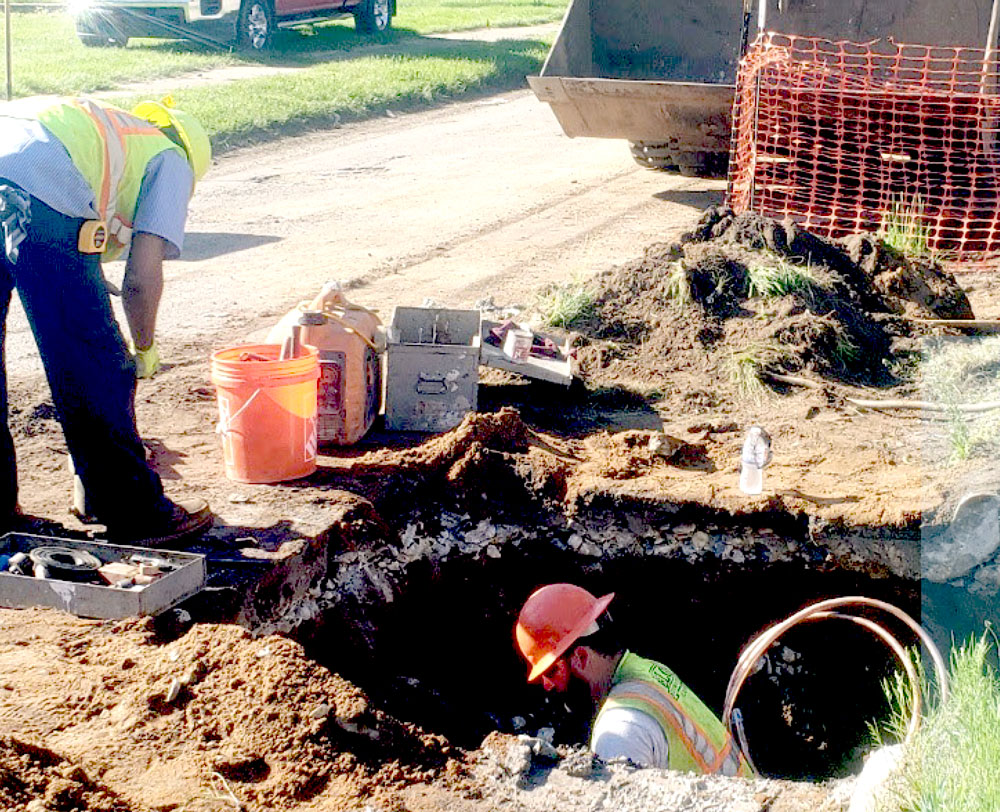
A $3 million DWSRF principal forgiveness loan was being offered to replace lead service lines. PHOTO COURTESY OF EPA
Communities across the country are undertaking similar efforts as they work to identify and replace lead service lines. According to EPA’s 2024 DWSRF Annual Report, released in November 2025, 743 lead service line replacement projects received $850 million in Infrastructure Investment and Jobs Act funding through the program from state fiscal years 2022 through 2024.
It varies from community to community, but in Des Moines, the homeowner owns the entire service line, from the connection at the water main to the house. This line can consist of different materials, including lead, copper, galvanized steel and PEX.
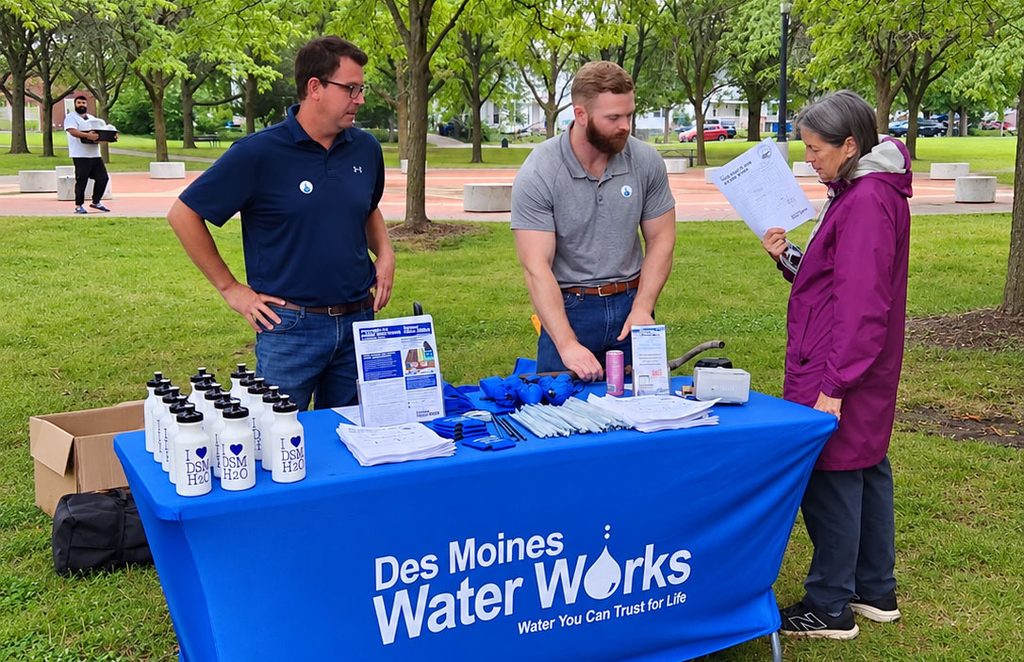
“We’ve had a lot of education with the community, just ensuring they know and understand that they own the service line, how to find it, how to find the water meter in the basement,” she said.
The communication aspect of the project has been challenging. Walker said they had anticipated homeowners being receptive to the offer of a free water service line, but many emails and phone calls have gone unanswered. Ultimately walking the neighborhood and the use of door hangers have proved to be the most effective — and time-consuming — means of reaching people.
“My hope is as more projects are done, it becomes wider spread and people see it and they hear about it, and they’re like, ‘Oh, it’s our turn,’” she said.
Mike Zach, P.E., engineering supervisor at Des Moines Water Works, said they started by having the property owner sign a right-of-entry (ROE) agreement, which allows them to work on private property.
They then verify the service line material through a process called hydro excavation, also known as “potholing,” on both sides of the stop box because it’s common for each side to be made of a different material.
“Essentially, it’s a visual inspection with a magnet test on top of that,” Zach said. “So we pothole down to the service line. We’re looking at it, looking at things like color, shape. The lead service line there’s a really dead giveaway — there’s a nice kind of bulbous shape at those leaded connections,” while galvanized pipes are magnetic.
Zach said the workers photograph the service lines and upload everything to a replacement tracking dashboard before sharing the results with the property owner. They use a door hanger that notes what the service line material is on both sides of the stop box and outlines the next steps.
“If it’s a lead or galvanized line, we’re telling the customer that we’re going to be reaching out to schedule an appointment with you,” he said.
After conducting a pre-construction survey inside the property to make sure there are no issues, Des Moines Water Works connects the owner with the contractor, who takes it from there.
Zach said in the older neighborhoods the water main is typically in the street, so the contractor must excavate a hole, no larger than 10 feet by 10 feet to access the service line connection at the water main. A second hole is required at the curb stop. The contractor performs the water main tap, installs the new line and abandons the existing connection.
While exact methods vary, Zach said, they are all trenchless, such as the use of a boring machine, pulling the old service line out while simultaneously pulling in the new service line, or a pneumatic mole.
The line from the main to the stop box is being replaced with copper, Zach said, while the material used from the box depends on whether the home has electrical grounds on the existing copper. If it does not, they will use PEX.
The contractor then flushes out the new service line to make sure there’s no sediment or debris in it and provides the customer with a lead-filtering pitcher to use for six months. The contractor is also responsible for the restoration of all surfaces that were disturbed in the process, including sidewalks, driveways and lawns.
The work undergoes several layers of inspection. Des Moines Water Works uses a consultant to conduct its own onsite inspections, while a city of Des Moines plumbing inspector reviews the newly installed service line. City right-of-way staff also oversee traffic control and restoration, including replacement of grass and pavement.
Moving forward, Zach said the realization that they needed to replace only about one-third of the service lines they anticipated has changed their approach. Rather than including potholing and replacement work in one contract, they will now bid them separately. This approach provides greater certainty in project quantities and reduces unnecessary communication efforts.
“Then we’ll get a better idea of what our records are, and we can develop that replacement contract based on way better, accurate data,” he said. “We know exactly what materials are in the ground and can base the replacement project on that.”
Des Moines Water Works selected the initial neighborhood based on federally determined criteria from the Iowa Department of Natural Resources (DNR), and Zach said some homeowners who know they have lead service lines are proactively contacting them to see when it is their turn.
While he can’t always give them a specific answer, there is something they can do.
“There is a self-reporting material form where they can actually go down in their basement, pull out their cell phone, and it’s an online form that allows them to submit what type of material they have coming into the house,” Zach said. “It’s good information for us to have, it helps with our inventory, so we ask people to do that.” Eventually, he said, they will have people submit an ROE.
Reflecting on the replacement process so far, Zach said it all starts with building relationships, whether with property owners, contractors or departments within the city of Des Moines.
“Everyone from the city of Des Moines has been super easy to work with,” he said. “The plumbing department has some great people who help us work through some of these situations, so we’ve been pretty lucky in that aspect.”
Des Moines Water Works recently announced it will inspect service lines at another 1,000 addresses, beginning with the service line on both sides of the stop box to determine whether replacement is necessary. If it is, the utility will contact the homeowner.
“That was one of the things that we discovered that we think will be able to move this a lot faster,” Walker said. “Instead of waiting for the permissions and then doing the inspections, we’re just going to bang out the inspections, and then we’ll come back through with seeking the permission.”

Mike Flenniken
Mike Flenniken is a staff writer, Marketing and Communications, for IAPMO. Prior to joining IAPMO in 2010, Flenniken worked in public relations for a group of Southern California hospitals and as a journalist in writing and editing capacities for various Southern California daily newspapers.
Last modified: November 17, 2026