
March 26, 2026

From the 2024 UPC Illustrated Training Manual, Chapter 9 – VENTS
908.1.2 Vent Connection. Common vent sizing shall be the sum of the fixture units served but, in no case, smaller than the minimum vent pipe size required for a fixture served, or by Section 904.0.
The common vent serving a lavatory that wet vents a kitchen may be 1 1/2 inch according to Table 703.2, but must increase to 2 inches if the lavatory is wet venting a toilet, even though the wet vent portion is a minimum 2 inches, since the toilet requires a minimum 2 inch vent (see Figure 908.1a).
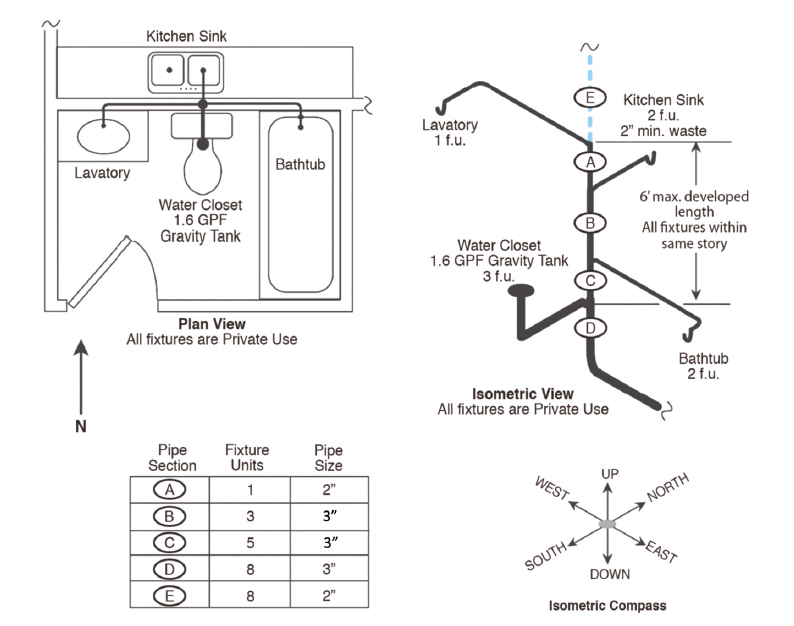
WET VENT SIZING EXAMPLE 1
The common vent may also need to increase if it is used for aggregate venting according to Section 904.0. Notice in Figures 908.1.2a and 908.1.2b the reduction in the amount of vent piping when vertical wet venting is applied as well as examples for sizing.
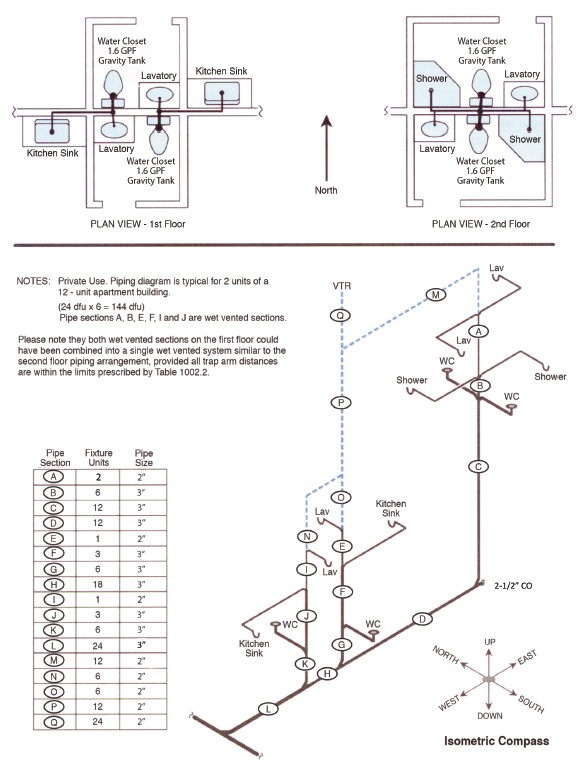
WET VENT SIZING EXAMPLE 3
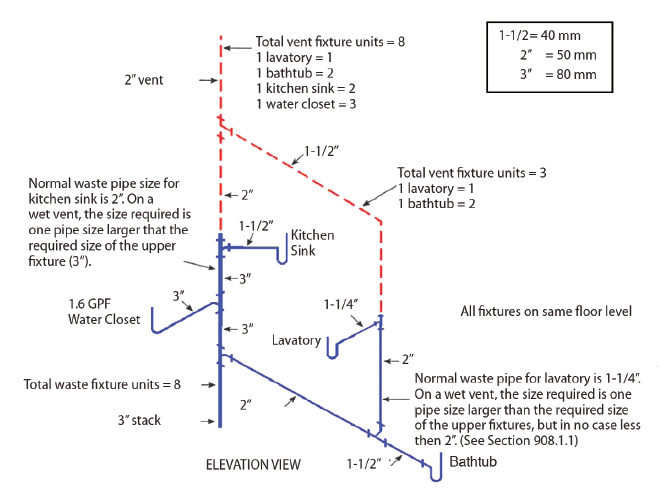
WET VENT SIZING EXAMPLE 4
From the 2024 UMC Illustrated Training Manual, Chapter 5 – EXHAUST SYSTEMS
511.1.2.1 Accessibility. If the design or positioning of the fan allows grease to be trapped, a drain directed to a readily accessible and visible grease receptacle not exceeding 1 gallon (4 L), shall be provided. In-line exhaust fans shall be located in easily accessible areas of adequate size to allow for service or removal. Where the duct system connected to the fan is in an enclosure, the space or room in which the exhaust fan is located shall have the same fire resistance rating as the enclosure. [NFPA 96:8.1.3.4 – 8.1.3.6]
Due to the flammability of the collected grease, accessibility and visibility is required to keep the receptacle from overflowing. The receptacle is limited to 1 gallon for the same fuel-loading reason.
These sections also allow the designer to provide a space in the building for the fan. In this case, the room or enclosure is required to be large enough to allow for service and removal of the fan and the enclosure shall meet the same rating as required by Section 510.7. Grease duct and fans are required to be inspected for grease build-up at an annual or more frequent interval as per Section 514.3. Access to the fan enclosed in the building or located external to the building should be provided with no less than required for access to other HVAC equipment according to Chapter 9 of this code.
(This is not to be considered the official position of IAPMO, nor is it an official interpretation of the Codes.)

IAPMO
IAPMO develops and publishes the Uniform Plumbing Code®,the most widely recognized code of practice used by the plumbing industry worldwide; Uniform Mechanical Code®; Uniform Swimming Pool, Spa and Hot Tub Code®; and Uniform Solar Energy, Hydronics and Geothermal Code™ — the only plumbing, mechanical, solar energy and swimming pool codes designated by ANSI as American National Standards — and the Water Efficiency Standard (WE-Stand)™. IAPMO works with government, contractors, labor force, and manufacturers to produce product standards, technical manuals, personnel certification/educational programs and additional resources in order to meet the ever-evolving demands of the industry in protecting public health and safety.
Last modified: March 26, 2026