August 6, 2026
From the 2024 UPC Illustrated Training Manual, Chapter 7 – SANITARY DRAINAGE
704.3 Commercial Sinks. Pot sinks, scullery sinks, dishwashing sinks, silverware sinks, and other similar fixtures shall be connected directly to the drainage system. A floor drain shall be provided adjacent to the fixture and shall be connected on the sewer side of the sink. No other drainage line shall be connected between the floor drain waste connection and the fixture drain. The fixture and floor drain shall be trapped and vented in accordance with this code.
Where direct connections exist for these types of kitchen equipment, a floor drain must be provided adjacent to the fixture and connected on the sewer side of the floor drain trap. No other drainage waste connection is permitted to connect between the floor drain and the fixture drain. This practice provides protection for the fixture drain of such sinks in the event of a blockage downstream of the drain. The floor drain provides a visual indication of stoppage since drainage will rise up onto the floor through the floor drain before ever contaminating the sink (see Figure 704.3).
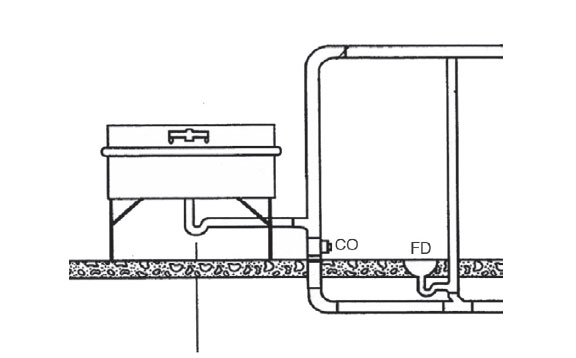
POT SINK WITH FLOOR DRAIN
From the 2024 UMC Illustrated Training Manual, Chapter 8 – CHIMNEYS AND VENTS
802.7.2 Termination. The termination of single-wall metal pipe shall meet the following requirements:
(1) Single-wall metal pipe shall terminate at least 5 feet (1524 mm) in vertical height above the highest connected appliance draft hood outlet or flue collar.
(2) Single-wall metal pipe shall extend at least 2 feet (610 mm) above the highest point where it passes through a roof of a building and at least 2 feet (610 mm) higher than any portion of a building within a horizontal distance of 10 feet (3048 mm).
(3) An approved cap or roof assembly shall be attached to the terminus of a single-wall metal pipe. [NFPA 54:12.8.3]
Sections 802.7.1 through 802.7.2 provide the limitations under which single-wall metal pipe can be installed.
The limitations are based on the fact that single-wall metal pipe can operate at a high temperature that easily can ignite combustible material placed in contact with it. When this type of pipe passes through a combustible roof, protection of the roof is required and a thimble is specified.
(This is not to be considered the official position of IAPMO, nor is it an official interpretation of the Codes.)
IAPMO
IAPMO develops and publishes the Uniform Plumbing Code®,the most widely recognized code of practice used by the plumbing industry worldwide; Uniform Mechanical Code®; Uniform Swimming Pool, Spa and Hot Tub Code®; and Uniform Solar Energy, Hydronics and Geothermal Code™ — the only plumbing, mechanical, solar energy and swimming pool codes designated by ANSI as American National Standards — and the Water Efficiency Standard (WE-Stand)™. IAPMO works with government, contractors, labor force, and manufacturers to produce product standards, technical manuals, personnel certification/educational programs and additional resources in order to meet the ever-evolving demands of the industry in protecting public health and safety.
Last modified: August 13, 2026