
There is a phrase I find myself returning to often when I speak with engineers, installers, and code officials about building water systems: water safety is not something you can retrofit. You can remediate it, expensively and with enormous disruption, but the most effective time to protect the integrity of a potable water system is before a building opens its doors. In fact, the most critical window of opportunity may be the one that receives the least formal attention in our industry: the construction phase itself.
That is precisely why I am proud of the work IAPMO has done in publishing the Manual of Recommended Construction Practices for Potable Water, and why I believe every professional who touches a building water system, from the design engineer to the plumbing inspector, should have it on their desk.
The Invisible Threat:nWaterborne Pathogens and the Case for Resilience
When we talk about resilience in the built environment, conversations often center on structural systems, power redundancy, or emergency water storage. These are legitimate concerns. But resilience has a less visible and arguably more consequential dimension: the microbial safety of the water flowing through a building’s pipes from the moment the system is first filled.
Opportunistic premise plumbing pathogens, or OPPPs in the parlance of water quality science, are organisms that exploit conditions within building water systems to grow, proliferate, and cause disease. Legionella pneumophila, the bacterium responsible for Legionnaires’ disease, is the most prominent example, but it is far from the only one. Pseudomonas aeruginosa, nontuberculous mycobacteria, free-living amoebae, and others in this class can establish themselves under the right conditions: stagnation, temperatures in the range of 68 to 113 degrees Fahrenheit (the optimal growth range for Legionella), disinfectant decay, and biofilm formation. Once established, these pathogens do not simply disappear when a building is commissioned and occupied. They persist. They adapt. And they can cause serious, sometimes fatal illness in the populations our buildings are designed to serve.
The data on this are sobering. Since 2000, reported cases of Legionnaires’ disease in the United States have been increasing, with the rate nearly quadrupling from 2000 to 2014 alone. The CDC’s national burden study estimates that biofilm-associated pathogens, specifically Legionella, Pseudomonas, and nontuberculous mycobacteria, account for the majority of waterborne disease hospitalizations and deaths in the United States, with direct health care costs of approximately $2.39 billion annually. These numbers alone should command our attention.
But here is the piece of the picture most directly relevant to construction professionals. According to the IAPMO Manual of Recommended Construction Practices for Potable Water, 75% of the unmanaged external changes that have resulted in outbreaks of Legionnaires’ disease were attributable to construction activities. The underlying CDC data are instructive: a landmark study of 27 building associated Legionnaires’ outbreaks investigated between 2000 and 2014 found that 35% involved unmanaged external changes, and of those, nearby construction was among the most frequently identified contributors.The scientific foundation for understanding this linkage was established through a series of peer-reviewed studies led by Dr. Molly M. Scanlon, PhD, FAIA, FACHA, then serving simultaneously as director of Research and Innovation at Phigenics and as adjunct faculty at the University of Arizona’s Mel and Enid Zuckerman College of Public Health. Her 2020 systematic review, co-authored with colleagues at Phigenics and Gordon Architectural Design, synthesized evidence across 31 studies spanning five decades of construction-associated waterborne disease events and established a rigorous framework for categorizing construction activity risk factors.
Building on that foundation, a 2022 study introduced the Water Management for Construction Infection Control Risk Assessment (WMC-ICRA), a structured tool adapted from the health care infection control field and designed to address the persistent gap between construction activities and water management program requirements. A 2023 follow-on study extended this work further by proposing a building water quality commissioning schedule method, a practical tool for aligning construction, commissioning, and water management activities to ensure systems achieve water quality and safety benchmarks prior to patient care operations. Whatever ‘the precise share attributable to construction in any given dataset, the directional conclusion drawn from this body of research is consistent: construction activities represent a significant, under appreciated driver of pathogen risk in building water systems, and the tools to manage that risk, when properly applied, are available.
Unmanaged construction activities create precisely the conditions that OPPPs need to thrive: extended periods of no or low flow, sediment and debris introduced during installation, water temperatures that drift into the pathogen growth range in an unconditioned building environment, and cross-connection risks that can introduce contamination into otherwise clean piping.
Consider the full lifecycle of what happens before beneficial occupancy. A building’s water system may be partially filled and then sit for weeks or months, exactly the stagnation conditions under which disinfectant residuals decay, bacteria multiply, and biofilms establish themselves on pipe walls. When the system eventually enters normal operation, those populations do not reset. They become the baseline from which occupants are drawing water on day one.
The resilience of a building water system is not just about how it performs over decades of operation. It depends fundamentally on whether it starts clean. This is where the industry has had a documented gap, and where IAPMO has stepped in to fill it.
What the Manual Does: A Practical Roadmap for Construction-Phase Water Safety
IAPMO’s Manual of Recommended Construction Practices for Potable Water was years in the making. On Sept. 15, 2021, IAPMO initiated a task group to create a manual that would provide code-enhanced, adoptable language for construction use related to potable water piping systems and water safety management during the construction phase. ESPRI, the Environmental Science, Policy, and Research Institute, played a central technical role in the manual’s development, contributing the depth of water quality science and building systems research expertise that allowed the task group to ground its recommendations in evidence rather than convention. The task group ultimately comprised more than 30 industry experts from across the nation: design engineers, plumbers, public health professionals, code officials, water quality scientists, and water system operators, all focused on one mission, making water safety practical and actionable for plumbing professionals. The manual was formally published in March 2024.
The scope is comprehensive. The manual covers new construction, renovations, expansions, and building additions across a wide range of occupancy types: commercial and institutional buildings, health care facilities, hotels and hospitality, educational institutions, gyms, multi-family residential, and more. Critically, the manual establishes a tiered framework based on building type and risk profile. Category A buildings (singlefamily residences and similar small buildings) face the lightest administrative requirements, while Category D buildings, which include health care facilities and buildings serving elderly or immunocompromised populations, are subject to the most rigorous water management requirements. This risk-based approach is one of the manual’s most practically useful features, because it allows all stakeholders to allocate their attention and resources proportionately.
What does that look like in practice? For Category D buildings, the manual requires a formal, documented Water Management Program, monthly Legionella sampling from at least 5% of plumbing fixtures, and daily water turnover in all filled system components.
For Category C buildings, which include schools, hotels, large offices, and gyms, water turnover is required at least once every three days, with monthly Legionella sampling. Even for lower-risk Categories A and B, the manual establishes baseline expectations for sanitary material handling, cross-connection control, initial flushing, and filling practices that apply to all building types.
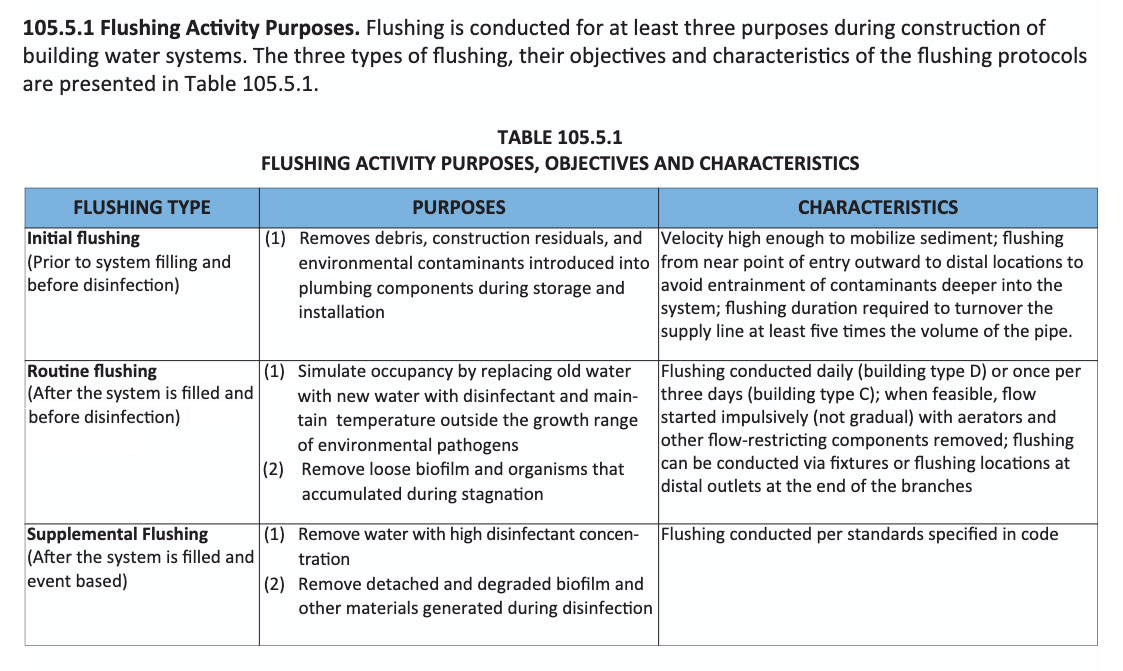
GRAPHIC COURTESY OF IAPMO
Flushing is where the manual breaks particularly important new ground, and it is the area most likely to be misunderstood or under implemented in the field.
The manual identifies three distinct types of flushing, each serving a different purpose in the construction-phase water management lifecycle.
Initial flushing is conducted when the system is first connected. Its primary objective is physical: removing debris, sediment, construction residuals, and environmental contaminants introduced into plumbing components during storage and installation. This flush must be conducted sequentially, working from the service line toward the distal system segments, specifically to avoid entraining contaminants deeper into the system. The target velocity is 5 feet per second, high enough to mobilize and transport sediment.
For portions of the system unable to achieve that target, the minimum acceptable velocity is 2.5 fps. To put these numbers in concrete terms for field use, achieving 5 fps in a 1-inch copper Type L pipe requires approximately 12.86 gallons per minute; in a 2-inch copper Type L pipe, nearly 50 gallons per minute. This is not a garden-hose flush. It requires planning, adequate drainage, and flushing points that are designed into the system from the beginning. Aerators, showerheads, and other flow-restricting components must be removed before flushing to achieve required velocities.
The manual is equally specific about duration. Because of the hydraulics and mixing characteristics of real piping systems, passing one pipe volume of water through a section does not reliably remove contaminants. A minimum of four to five pipe volumes must be flushed to achieve a high level of contaminant removal.
Routine flushing is conducted after the system is filled and before final disinfection. Its objectives are microbial: simulating occupancy by replacing stagnant, aging water with fresh supply water carrying disinfectant residual, and removing loose biofilm and organisms that accumulated during stagnation.
The manual recommends opening valves quickly rather than gradually, to produce a rapid change in shear at pipe walls, which research has shown promotes more effective biofilm removal. The frequency requirements are specific: daily for Category D buildings, and at least once every three days for other building types.
Supplemental flushing follows pre-occupancy disinfection. After a high-concentration disinfectant solution has been held in the system for sufficient contact time, post disinfection flushing removes the concentrated disinfectant, inactivated organisms, and degraded biofilm materials released during the disinfection process.
The manual also addresses an issue that comes up constantly in conversations with design professionals: the importance of flushing points in the system design itself. Flushing points for key segments of the system, including the service line, cold and hot water distribution trunks, and hot water recirculation loops, must be included in the design from the beginning, sized to achieve target scouring velocities, and paired with drainage capable of accommodating the required flows. Designing in flushing points is not a luxury; it is a prerequisite for executing the water management practices the manual requires.
Pre-installation material management is another area of emphasis. Pipes, fittings, and other plumbing components staged on jobsites are exposed to conditions, including temperature extremes and biological contamination from soils and natural waters, that can compromise their internal surfaces before installation begins. Legionella, Mycobacterium, free-living amoebae, and other environmental pathogens survive in soils and natural waters and are legitimate contamination risks for unprotected plumbing materials. The manual requires capping or wrapping pipes and valves, sealing the intake and discharge ports of water heaters and treatment devices, and storing components in well-drained areas. Components known or suspected to have been contaminated during storage must be flushed and disinfected before installation.
Construction water usage is another area where the manual breaks important ground. Potable water systems are routinely pressed into service during construction for toilet facilities, hydration stations, material mixing, washdown, and equipment with water reservoirs, creating backflow risks, crossconnection hazards, and flow conditions that differ dramatically from those during normal building operation. The manual provides specific cross-connection control requirements for each type of construction water use and is explicit that temporary piping must be completely removed before commissioning, to prevent the creation of dead legs that would persist as ongoing water quality risks into the building’s operational life.
The full management framework culminates in pre-occupancy disinfection (Section 107.11), which the manual correctly frames not as a stand-alone solution but as one element of a multi-step process. A fundamental theme running throughout the document is that there is a misplaced conception in our industry that disinfection alone is sufficient for ensuring a potable water system is ready for beneficial occupancy. The reality, and this is a point I feel strongly about, is that many potable water systems designed and installed by conscientious professionals — and disinfected according to requirements in place at the time — have entered service contaminated. Addressing water quality management across all construction activities does not guarantee a contamination-free system at beneficial occupancy, but it represents the highest standard of care available, and it will reduce the likelihood of contamination.
The manual is available to download at iapmo.org/research/manuals/constructionpractices-for-potable-water-manual, and it includes an important bonus annex: the IAPMO/ESPRI Manual of Water Quality for Plumbing Industry Professionals and Building Managers, which provides the foundational water chemistry knowledge, covering disinfectant residuals, temperature management, heterotrophic plate count interpretation, and more, that underpins the construction practices in the main document.
That the manual is freely available is an important starting point. The more meaningful measure is how widely it has reached the professionals responsible for specifying and overseeing construction phase water management. A 2025 straw poll of 30 licensed engineers and plumbing designers offers a useful benchmark: only 4% of respondents reported consulting the Manual of Recommended Construction Practices for Potable Water in their plumbing designs, compared to 89% who cited ASPE Handbooks as a primary reference. Authoritative Legionella-specific resources showed similar patterns: ASHRAE 188 was referenced by 11% of respondents, and ASHRAE 12 by just 7%. The data reflect a real opportunity, one that IAPMO and ESPRI are actively working to close through education, outreach, and direct technical engagement.
The Manual of Recommended Construction Practices for Potable Water is a significant expression of what that partnership looks like in practice. But it is only the beginning. Building water system resilience is not a problem that gets solved once and filed away. It requires ongoing research, continuously updated guidance, and the kind of expert engagement that can meet professionals where they are: on the jobsite, at the plan review counter, in the engineer’s office. For questions about ESPRI’s research and consulting capabilities, visit iapmo.org/research/espri.
The Manual of Recommended Construction Practices for Potable Water is available to download at: iapmo.org/research/manuals/construction- practicesfor-potable-water-manual.

Christoph Lohr
Last modified: July 14, 2026