
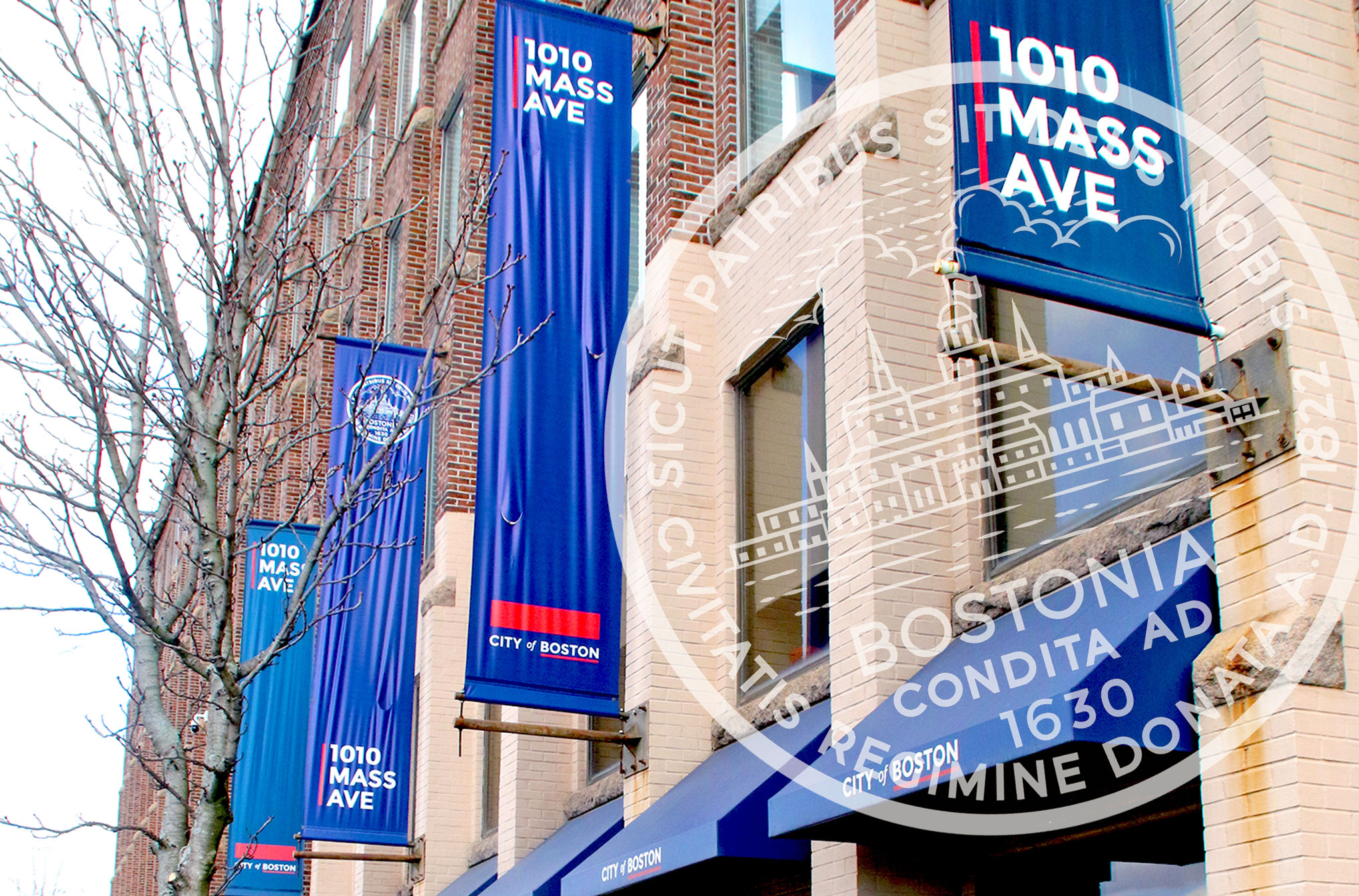
DESPITE DIFFERENT PERSPECTIVES AND ROLES, BOSTON’S PLUMBING LEADERS REMAIN UNITED BY A COMMITMENT TO SAFETY, EDUCATION AND STRONG CODE ENFORCEMENT. IAPMO IS THERE TO HELP
Few cities blend historic infrastructure and modern construction quite like Boston. Centuries-old brick buildings sit beside glass towers, narrow colonial streets feed into some of the country’s largest hospitals and universities, and longtime neighborhood institutions coexist with massive redevelopment projects reshaping the waterfront. From Fenway Park and the North End to the rapidly changing Seaport District, nearly every part of the city reflects a mix of old and new — a constant balancing act between preservation and progress.
Boston’s plumbing industry reflects many of the same contrasts found throughout the city itself. Contractors and inspectors work in centuries-old buildings one day and massive redevelopment projects the next. Historic neighborhoods, aging infrastructure and tight urban spaces create challenges that don’t exist in many newer cities, while apprenticeship training, continuing education and collaboration between inspectors, contractors, unions and organizations like IAPMO continue shaping the industry across Massachusetts.
Over the course of several stops across Boston — from the city’s Plumbing and Gas Inspectional Services Division and the UA Local 12 training center to a fabrication shop and active construction site — conversations often came back to the same topics: training, consistency, code enforcement and the relationships that help keep the industry moving.
Although Massachusetts maintains its own plumbing code, IAPMO has remained deeply involved in the state through continuing education, technical support and long-standing relationships with inspectors, contractors, unions and industry organizations.
Licensed plumbers and gas fitters in Massachusetts are required to complete 12 hours of continuing education every two years for license renewal, while plumbing and gas inspectors complete 24 hours during each renewal cycle.
Continuing Education
According to IAPMO Director of New England Training and Education Peter DeFreitas, IAPMO conducts more than 140 continuing education classes during each training cycle at more than 40 locations statewide and online, training more than 4,000 Massachusetts plumbers annually.
DeFreitas said IAPMO serves as the continuing education provider for the region’s four UA locals, including Boston’s UA Local 12, where classes are conducted monthly at the union’s Dorchester training facility. IAPMO also provides continuing education classes for inspectors throughout Massachusetts.
He described Massachusetts as having an extremely active plumbing board that oversees licensing, code implementation, product review and installation practices. DeFreitas said IAPMO representatives have worked with inspectors, unions and industry leaders for decades on continuing education requirements, curriculum development and technical support.
DeFreitas also said IAPMO conducts continuing education classes for Greater Boston Plumbing Contractors Association member companies and provides onsite training for plumbing crews at institutions including Boston University, MIT, Northeastern University and Wellesley College.
“The plumbing industry is strong in Boston and all across Massachusetts,” DeFreitas said.
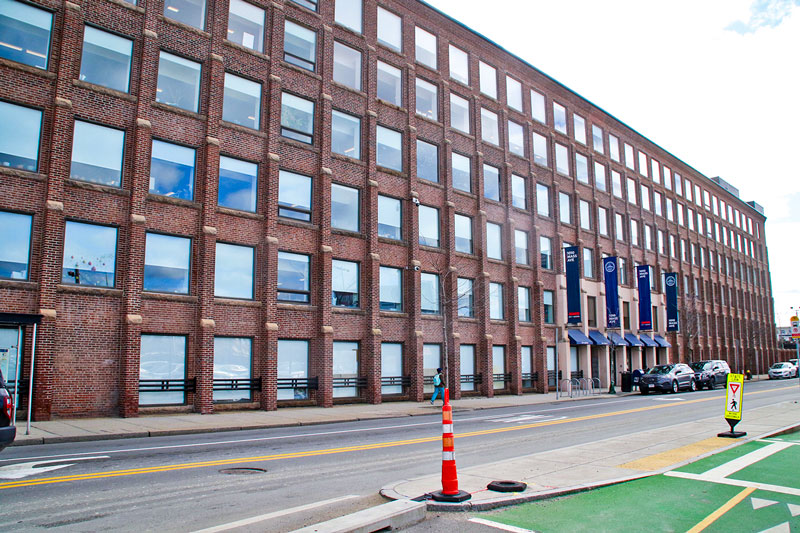
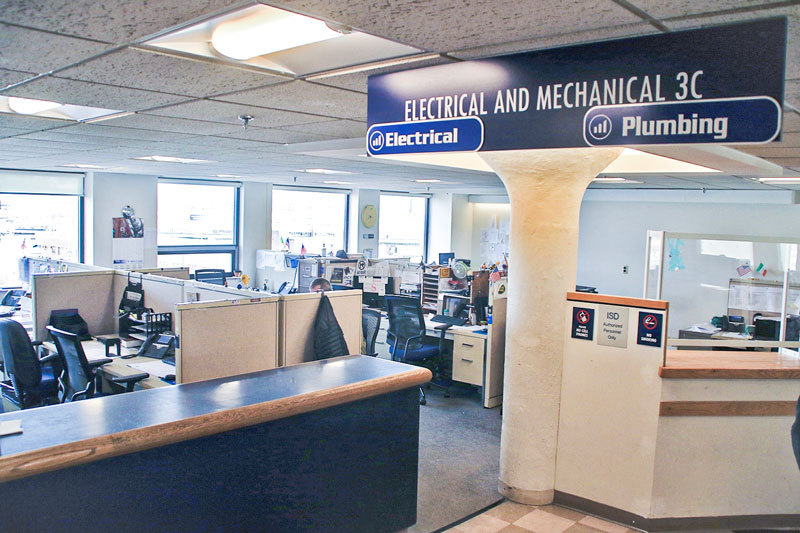
Boston ISD Plumbing and Gas
At the Boston Inspectional Services Department’s Plumbing and Gas Division, Supervisor Bill Foley was joined by Chief Plumbing Inspector Tim Davidson and inspector Joe McNamee, who also serves as chair of the state Board of Plumbers and Gas Fitters, along with IAPMO Field Services Manager Peter Kelly.
The Boston Inspectional Services Department’s Plumbing and Gas Division has seven inspectors covering the entire city, handling plumbing, gas and sprinkler inspections across 22 inspection areas. These zones are periodically reassigned, giving inspectors experience working throughout different parts of the city.
Inside the division offices, inspectors discussed the day-to-day challenges of overseeing plumbing and gas work across Boston.
The relationship between Boston’s plumbing industry and IAPMO stretches back decades through continuing education, technical support and collaboration between inspectors, contractors, unions and industry organizations.
“We always appreciated that we had our own code,” McNamee said, adding that it was likely based on IAPMO’s Uniform Plumbing Code (UPC®) when it was created in the 1960s.
“The biggest thing that’s come from the education is all the inspectors are on the same page,” Davidson said. “You go to the meeting, and ‘This is what you’re going to do. This is what everyone’s going to do.’ It’s better for the plumbers, I think.”
Continuing education classes also give inspectors opportunities to compare notes, discuss new products and review code changes together.
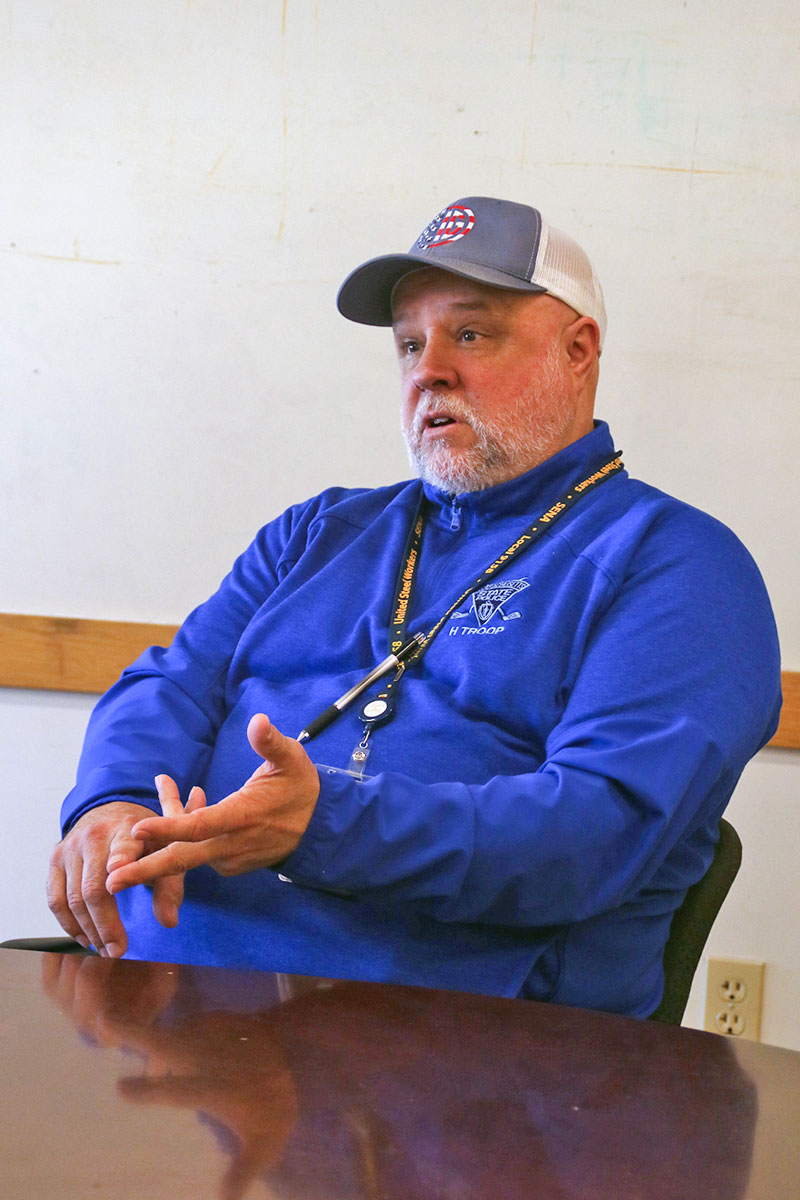
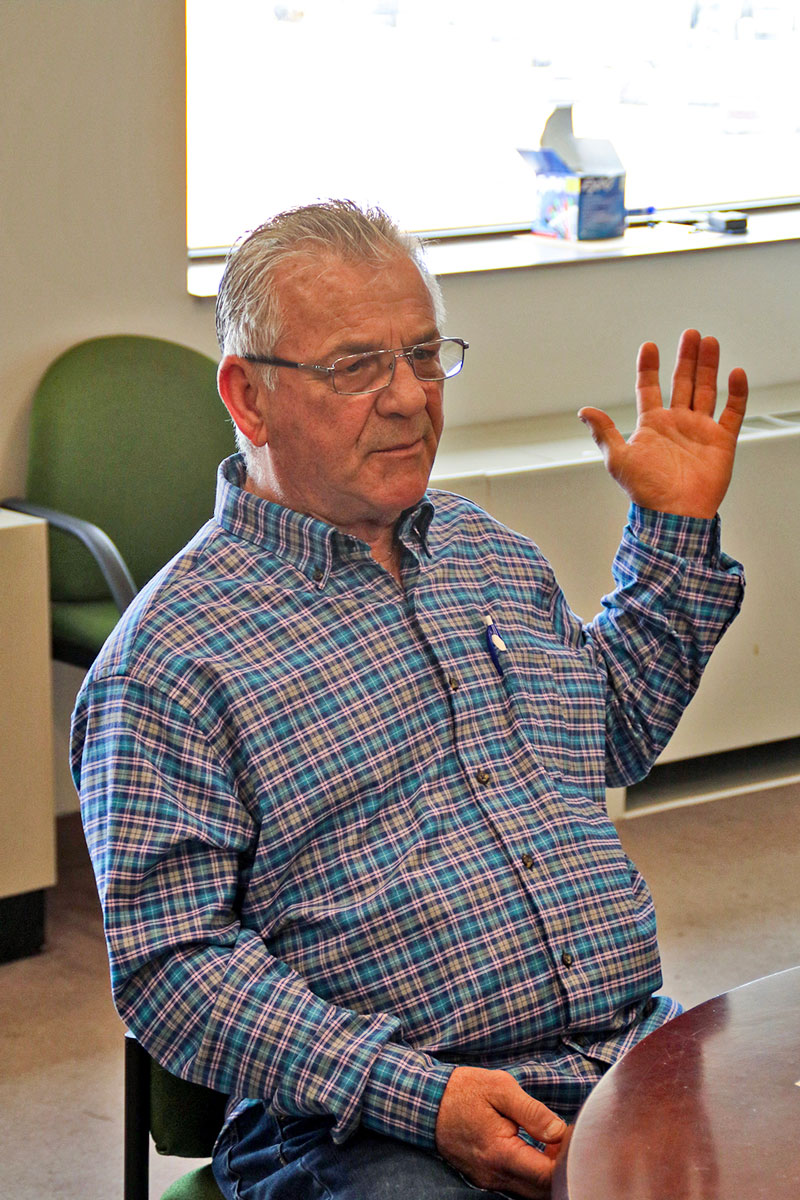
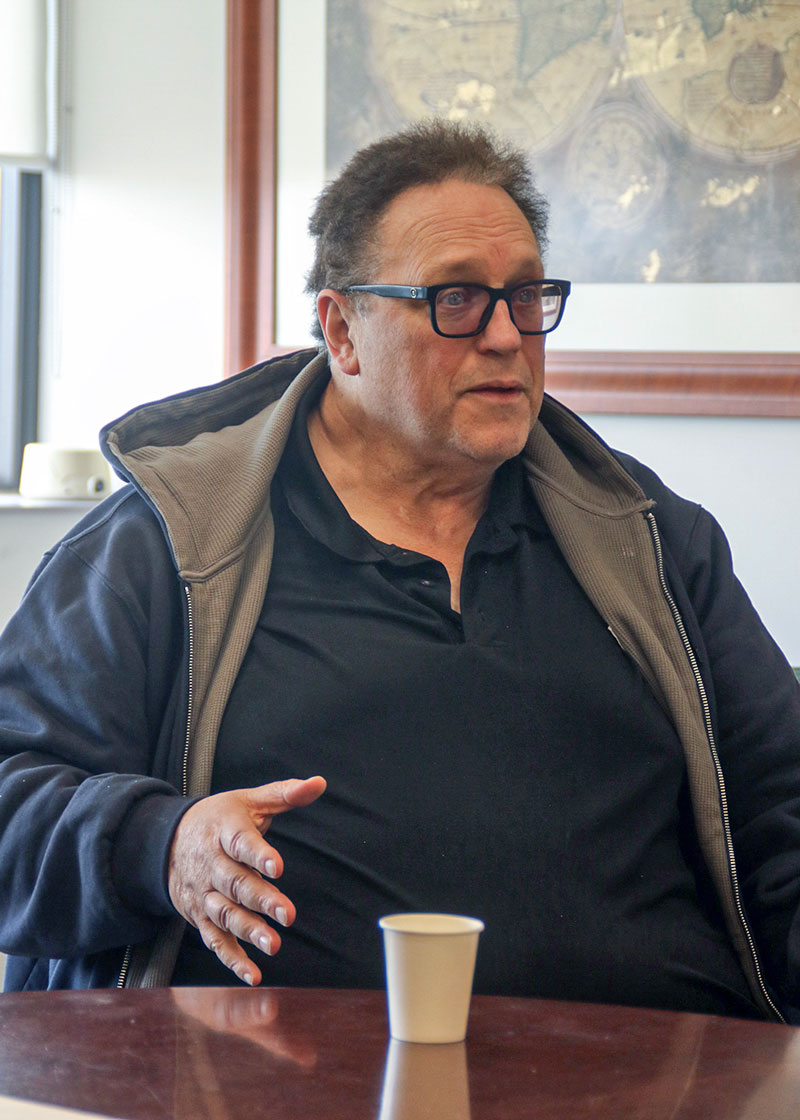
“You get to meet other inspectors and develop a camaraderie with them,” Foley said. “We don’t know everything, and you might forget sometimes. And when they upgrade, change the codes, the information goes out through the continuing education courses to everybody, which is good.”
Inspectors said much is shaped by Boston’s older infrastructure and dense neighborhoods.
“Very, very old,” Foley said. “There’s been a couple of cases where they found those old wooden water mains.”
Davidson described one project where workers uncovered sections of bored-out trees that once carried water beneath Boston streets.
“They were just trees, probably, 8, 10 inches around, just bored out,” he said.
Inspectors said they are also seeing older homes converted into multifamily housing, particularly in neighborhoods near colleges and universities.
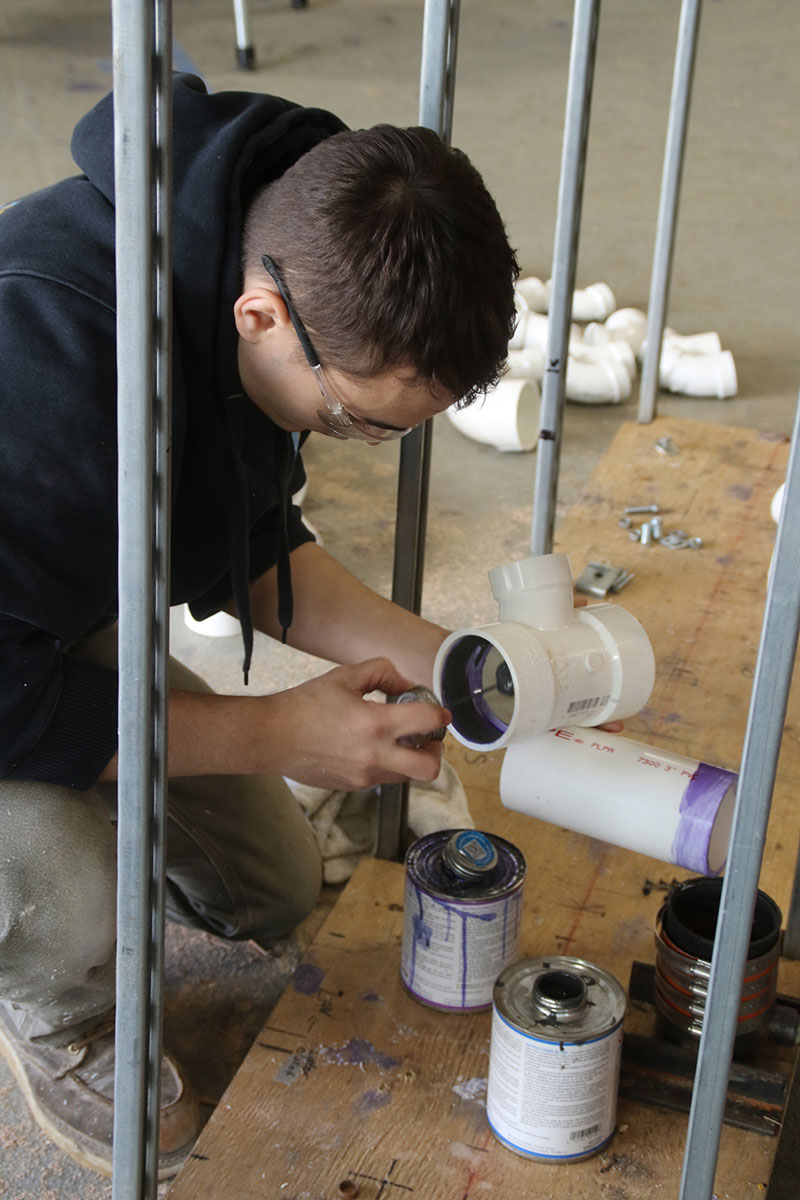
PHOTOS BY GEOFF BILAU
“Over in Southie, Ward 6 they call it, they have a lot of three families, four families,” Foley said. “Those all used to be singlefamily homes. So now what they’re doing is they’re taking a three-family, making three apartments, three bedrooms each, each bedroom has a bathroom. They rent them to college kids. And that’s a lot of what we see.”
Historic districts create additional challenges.
“We have a problem like down on the South End, Commonwealth Avenue, Beacon Street, with power venters leaving the building,” Davidson said. “Because neighbors see something, a power venter on the side, they see smoke coming out of it. That’s a problem with the historical.”
In some neighborhoods, plumbing and gas work can also lead to historic preservation concerns and neighborhood complaints.
“These guys that are putting it in don’t know it’s historical; they assume it’s just a brownstone,” Foley said. “So they put it in, we sign it off. Then we get a phone call saying, ‘Why’d you approve that?’”
The department also handles a constant workload tied to ongoing construction and redevelopment throughout the city.
“The turnaround with us for inspections is usually a day,” Foley said. “We used to be proud of day-of inspections.”
Still, large projects often may require multiple visits.
“We’re out there with the whole city,” Foley said. “I can’t come to your job and look at your whole building in one day. We’ll come out a couple times.”
Despite the pace and complexity, the department emphasizes responsiveness alongside enforcement.
“We’re all about customer service up here,” McNamee said. “We don’t want any complaints, we don’t want any problems.”
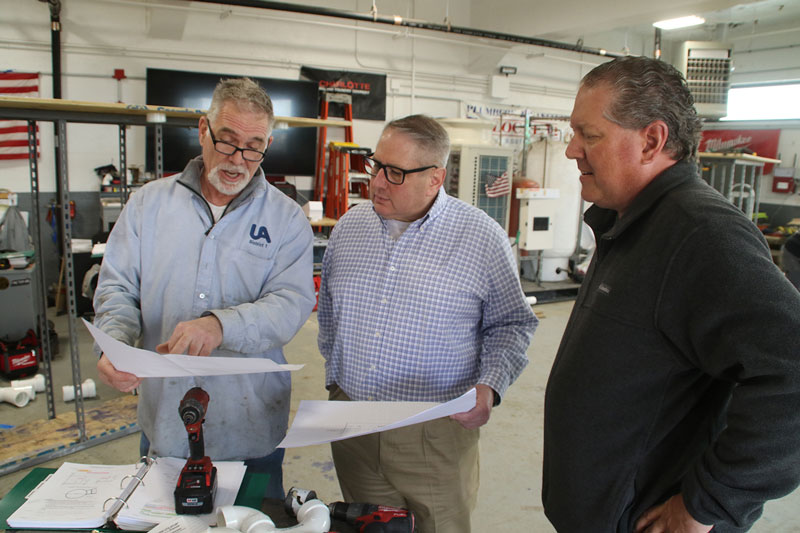
instructor Joe Kyne, left, reviews plans with Training Director Rick Carter, center, and IAPMO Field Services Manager Peter Kelly inside the training center. PHOTO BY GEOFF BILAU
UA Local 12 Training Center
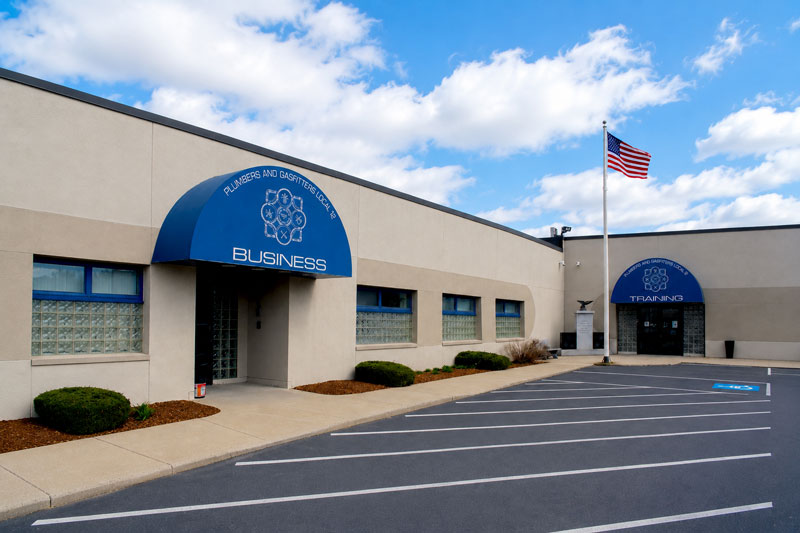
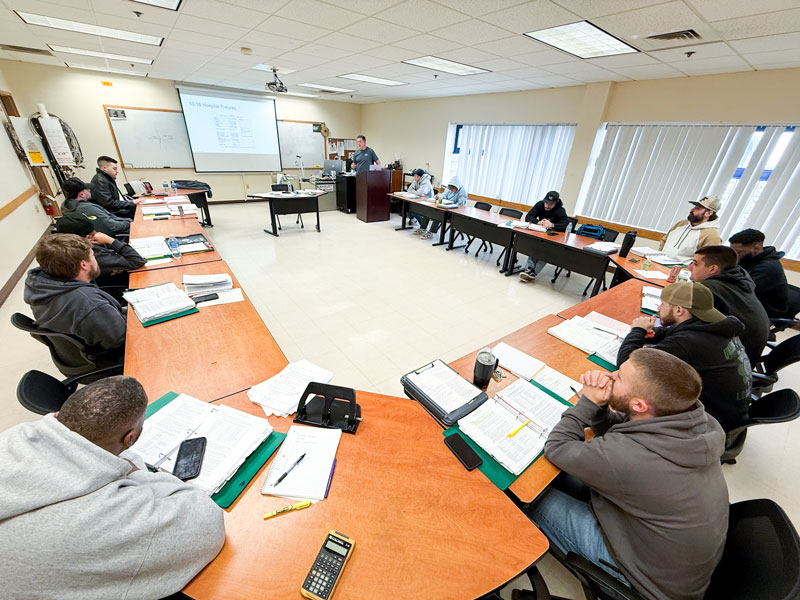
After leaving the ISD offices, the group traveled to the Plumbers and Gasfitters UA Local 12 training center in Dorchester, where apprentices rotated through classrooms and shop areas throughout the facility.
“We’re a full-time day program,” Training Director Rick Carter said. “We have our guys and girls come in six weeks a year for 240 hours of training in 40-hour blocks, so we get to do a lot more in-depth training with them instead of coming in at nights.”
Carter said the local shifted away from night classes in 2013.
“We were a night program with four hours a night, and that just wasn’t working out,” he said.
Local 12 has five full-time instructors and about 320 apprentices rotating through the program.
Carter said the full-time structure allows apprentices to spend significantly more time physically installing systems before returning to the field.
“They spend literally 80 hours installing plumbing, going through it,” Carter said. “And then when they go out into the field, they’re more apt to just get right on it with their journeymen.”
Inside one training area, apprentices worked on drainage and venting projects while instructors walked the group through the training exercises.
Joe Kyne, who has been an instructor for 33 years, said much of the training focuses on helping apprentices visualize drainage and venting systems within real-world space limitations, including floor heights, wet walls and ceiling clearances.
“If you can draw it, then you can install it,” he said.
Kyne said apprentices are constantly pushed to pay attention to layout details, measurements and notes rather than simply rushing through installations.
“It’s getting them to understand that it’s not just showing up and putting things together,” Kyne said.
At one station, apprentices worked on a two-story drainage and venting project designed to closely replicate real-world installation conditions.
“If you come back in a couple of days, this will all be filled with pipe,” Kyne said. “This replicates a two-story type of thing.”
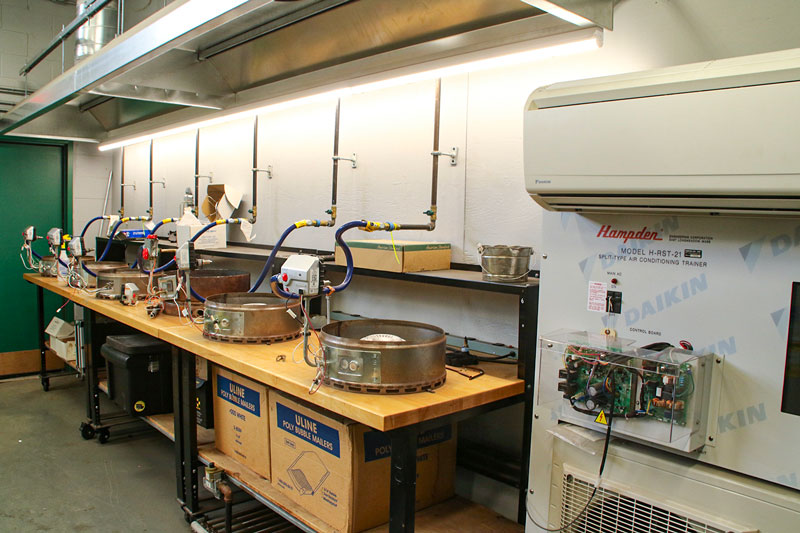
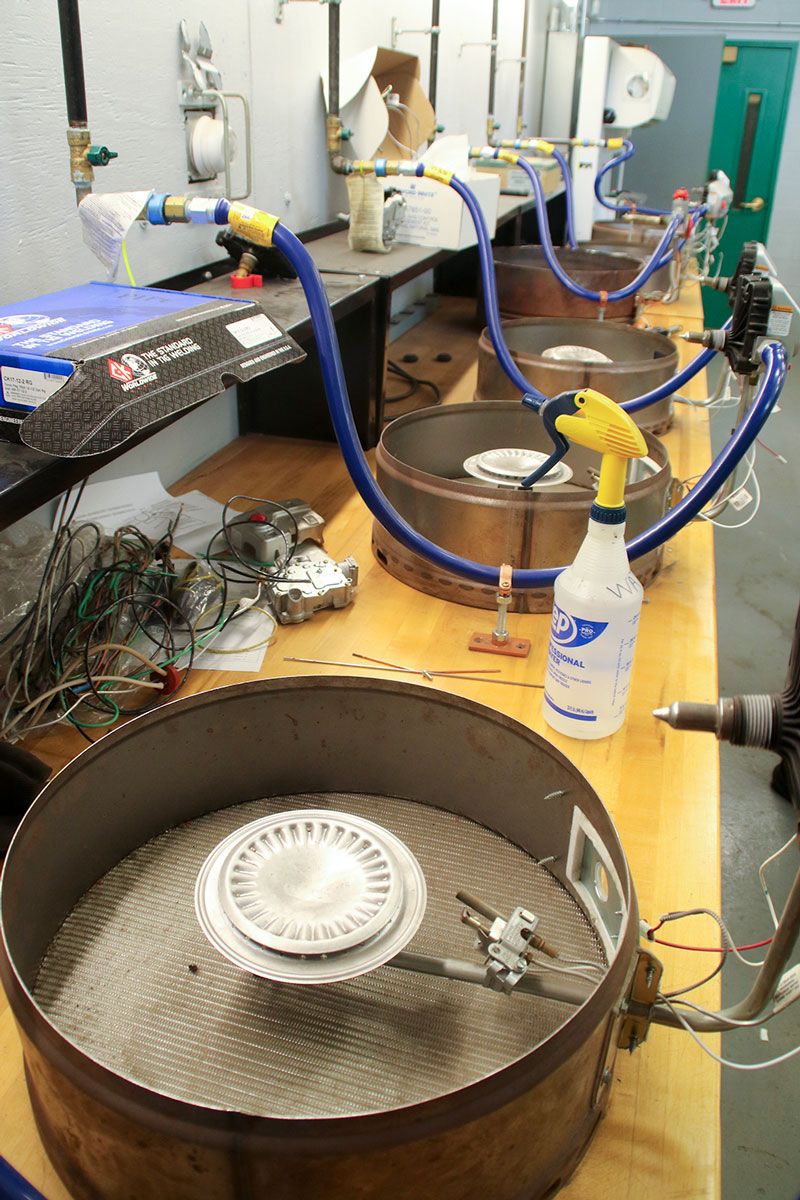
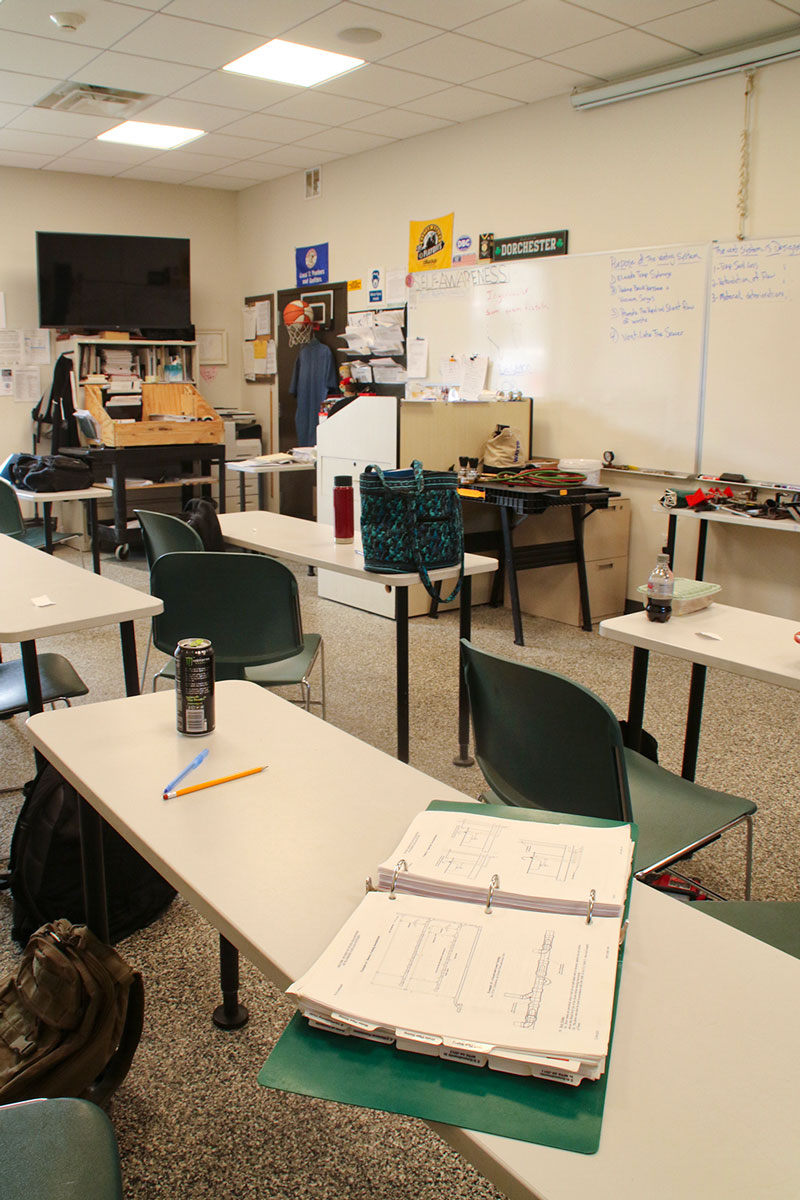
Students are directed to reference their code books to solve layout and venting problems on their own.
“We try to give them the least amount of information possible,” Kyne said. “So then we say, ‘Go read your code book. What does your code book say? What do you have do to be code compliant?’”
Rather than immediately correcting mistakes, instructors push apprentices to work through problems themselves.
“I let them fail drastically and then we bring them all back,” Kyne said. “I don’t want to give them the answer, but I’ll let them know that, ‘OK, wait, that’s not right; go and tell me why it’s not right.’”
Kyne said the goal is to prepare apprentices to think independently once they enter the field.
“There’s no one there to make a drawing for you; you have to make the drawing,” he said.
The projects are intentionally designed to simulate real-world conditions, including space limitations and time pressures apprentices will encounter on jobsites.
“We make them keep this, like we got a floor height they can’t go below here,” Kyne said. “So we’ve got a ceiling height. It’s not like you can just pipe it anywhere.”
Kyne said instructors also intentionally pair apprentices together rather than allowing them to choose their own partners.
“You don’t always get to work with the people you want to work with,” he said. “That’s your partner. Figure it out.”
Carter also discussed medical gas training, which he described as a major part of Local 12’s work in Boston.
“One of the big parts of our local here is medical gas,” Carter said. “A lot of places, there’s other people that do medical gas, but in the city of Boston, Local 12 and the plumbers do medical gas, so this is a med gas training room here where we have just like you would see in a regular hospital.”
Carter said the systems are built to NFPA 99 standards.
In another area, Carter pointed to different types of water heaters and evolving technologies being introduced to apprentices.
“This is the new heat pump water heater that I think the commonwealth wants to have 500,000 of in like 10 years,” Carter said. “That’s a pretty lofty goal and we are here to help make it happen.”
The tour also moved through areas focused on welding, soldering and residential systems training.
For Kyne, the focus remains on preparing apprentices not just to install systems, but to understand them.
“Again, they might have the knowledge, but they don’t have the experience,” Kyne said. “Nothing works the way it says it’s going to work. So you have to be able to think outside the box.”
Greater Boston PCA
On the way to the J.C. Cannistraro prefabrication facility, Andrew DeAngelo, executive director of the Greater Boston Plumbing Contractors Association (GBPCA), discussed the organization’s role representing union plumbing contractors across the region.
“We represent every union plumbing company that’s signatory of Plumbers Local 12,” DeAngelo said. “We represent them in contract negotiations, we represent them at the State House, at City Hall for legislative affairs, and also we do contractor education, continuing education.”
DeAngelo said the organization works closely with IAPMO on continuing education, licensing and legislative issues affecting the plumbing industry in Massachusetts.
“IAPMO and our association are pretty much in lockstep with each other in advocating for our current code, which is a pretty strong code,” DeAngelo said.
DeAngelo described the relationship between GBPCA and IAPMO as complementary when advocating for legislation and technical issues at the state level.
“Having IAPMO is sort of like having the stamp of an expert,” DeAngelo said. “We’re the union business community, and Peter [Kelly] and Peter [DeFreitas] represent an international organization that has brought together the best experts in the industry. From a technical standpoint, we kind of cover both sides of the ball there.”
DeAngelo said the organizations frequently work together on licensing, code and policy issues affecting the plumbing industry throughout Massachusetts.
“We take the mentality of a rising tide lifts all boats, and those high standards we think will elevate the entire industry, but then also elevate Massachusetts,” he said.
J.C. Cannistraro Prefabrication Facility
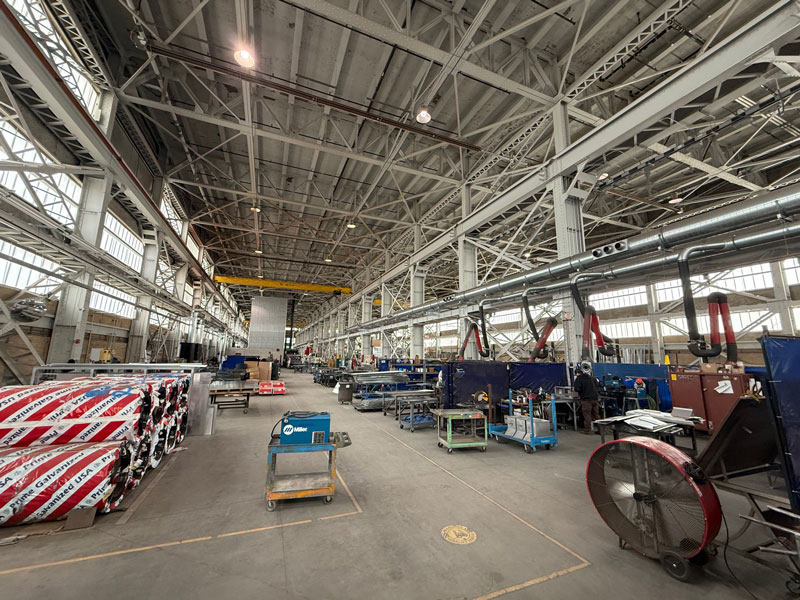
The next stop was J.C. Cannistraro’s prefabrication facility at 25 Fid Kennedy Ave. in the Seaport District.
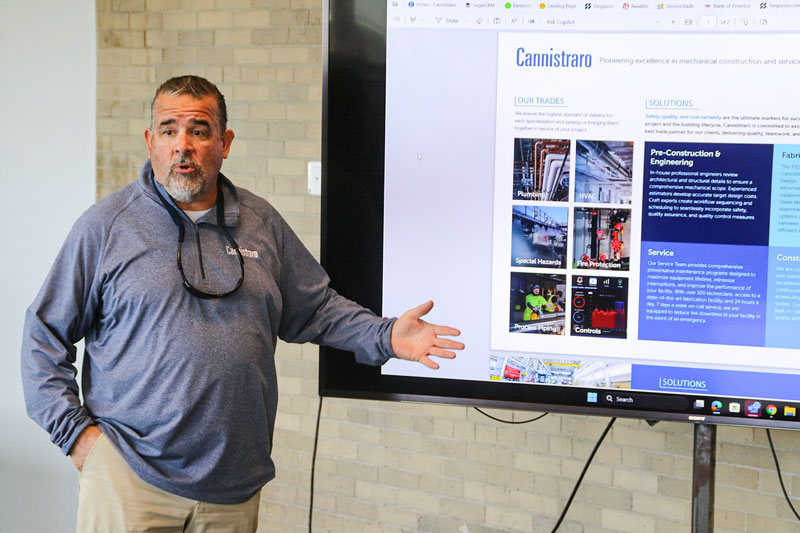
Kenneth Reagan, vice president of Business Development for J.C. Cannistraro and president of the Greater Boston Plumbing Contractors Association, said the company was founded in 1963 as a plumbing company in Watertown and has grown to more than 700 employees working across plumbing, HVAC, fire protection, process piping and controls.
Reagan said the company operates across multiple sectors of the mechanical trades throughout the Boston and Cambridge markets while increasingly expanding into surrounding areas. The company works across sectors including health care, education, life sciences, industrial and entertainment projects while providing services ranging from engineering and preconstruction to fabrication and installation.’
“We do just about everything as far as the one-stop shopping for the mechanical trades,” Reagan said.
The building, constructed during World War II, originally served as a machine shop supporting the war effort. The dry dock next door, which was visible from upstairs, is one of the nation’s oldest.
Cannistraro consolidated several smaller prefabrication operations into the facility after acquiring the building and renovating it around 2016.
“This warehouse is 150,000 square feet, with much of the space flexible to manage large fabrication projects,” Reagan said while leading the group through the shop floor.
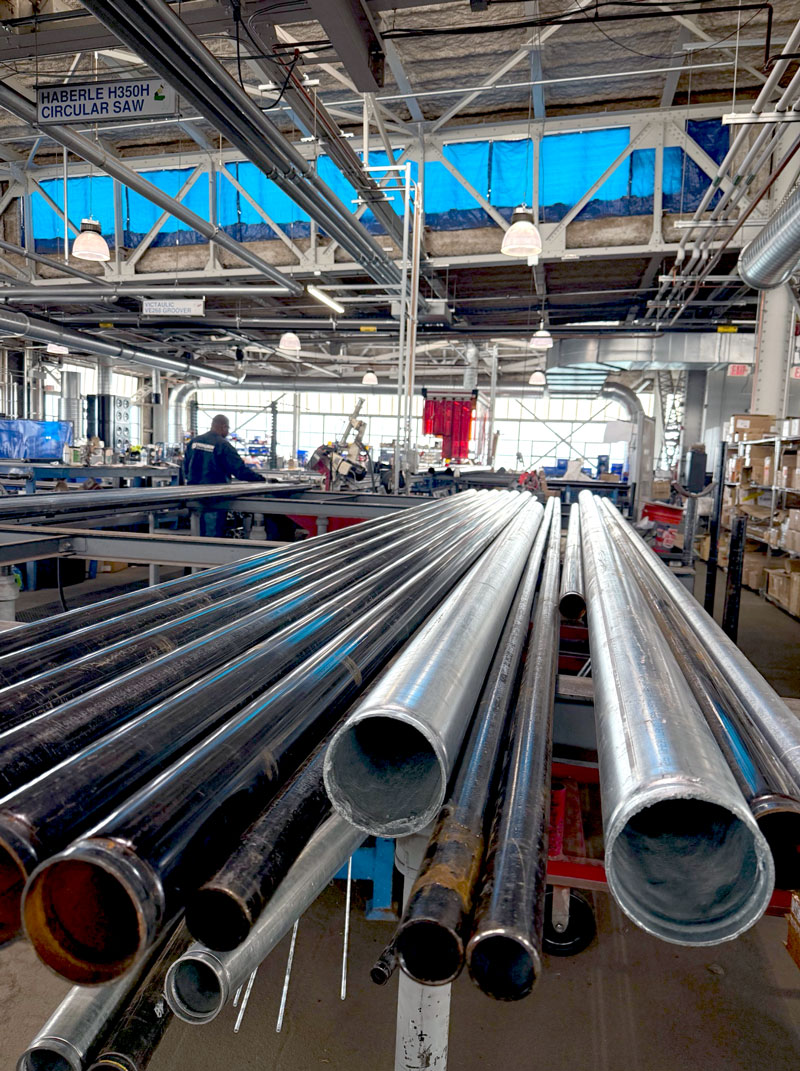
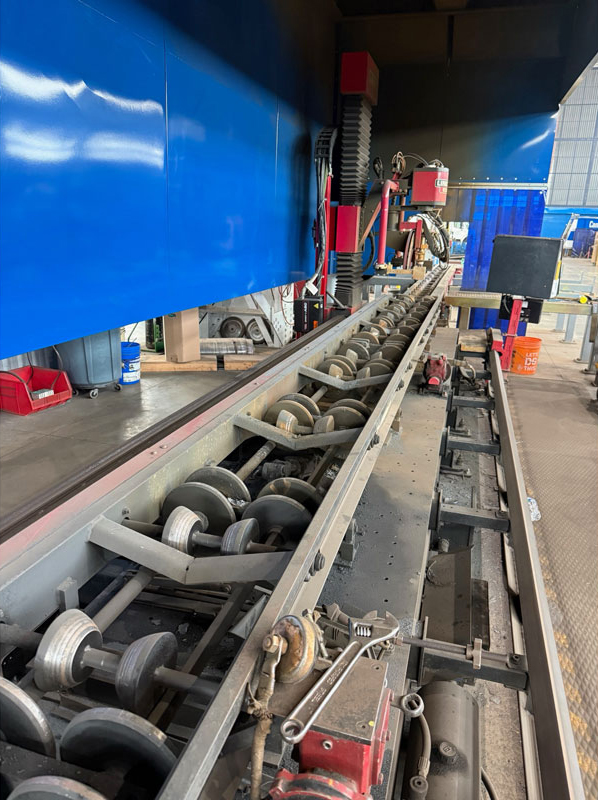
Inside the sheet metal fabrication area, large coils of metal fed through machinery that cut and formed ductwork for jobsites across the region.
Reagan said the operation functions almost like an assembly line, with ductwork engineered, drawn and fabricated before being shipped directly to projects.
“Everything gets engineered, drawn, and prefabricated in the sheet metal [division],” Reagan said.
PHOTOS BY GEOFF BILAU
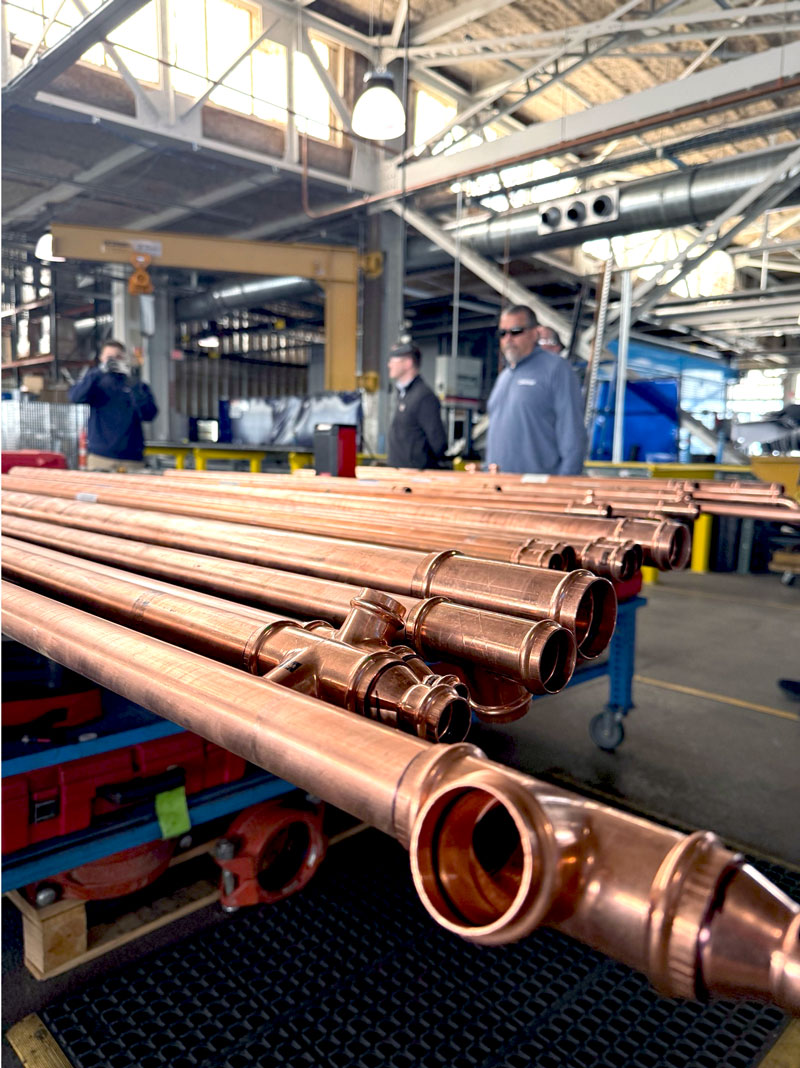
Further into the facility, the group passed welding booths, fire protection fabrication areas and rows of prefabricated piping systems staged on carts for delivery.
Reagan also pointed out a fire truck used by the company’s sprinkler division for standpipe and fire pump testing on projects throughout the city.
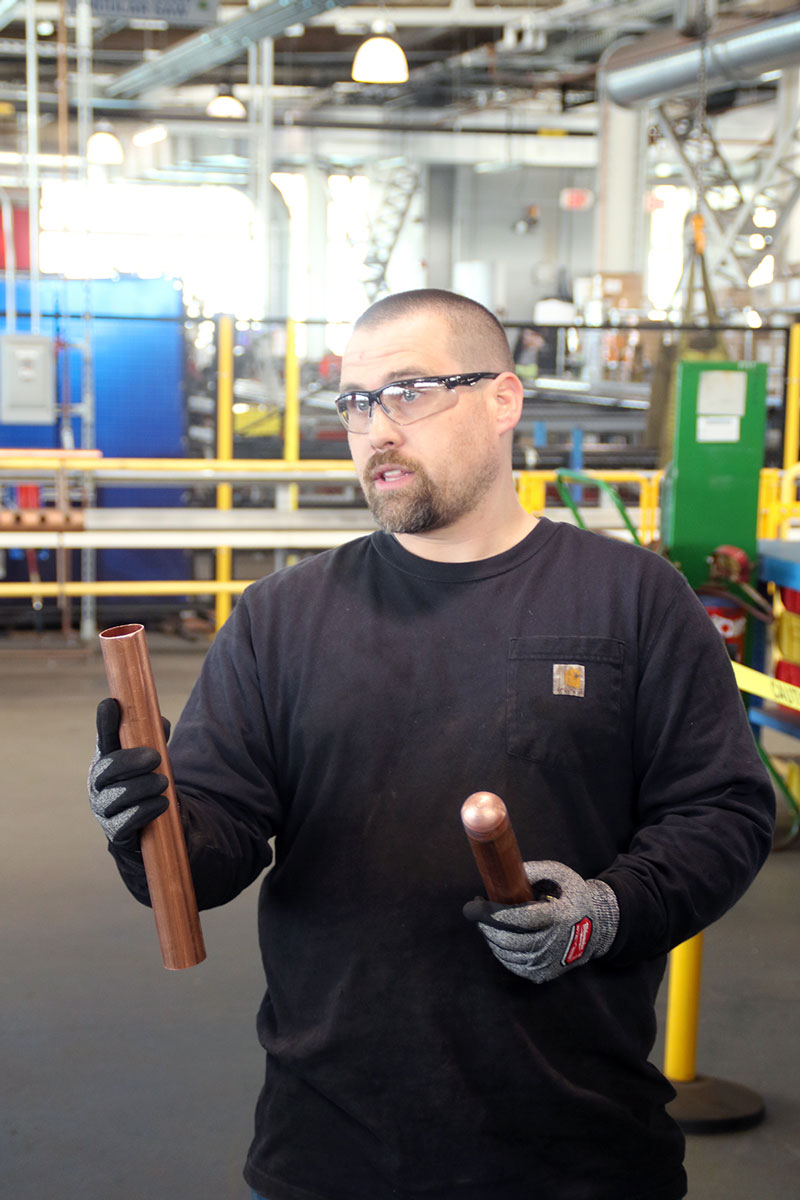
In the plumbing fabrication area, plumbing shop foreman Brian Janiak demonstrated several pieces of fabrication equipment used to reduce material waste and labor costs. One machine created copper “bullets” used during testing beneath sinks.
“So instead of buying the fitting, we can put a piece of pipe in that looks just like this, and it comes out looking like this,” Janiak said while demonstrating the machine. “We can do that all the way up to 4-inch with this machine.”
“Now this gets cut off and thrown away” after the pipe is tested, Reagan said. “It’s not nearly the expense of a ProPress cap or a soldered cap.”
Janiak also demonstrated a pull-T machine used to fabricate copper tee connections directly from pipe.
“This will eliminate it, because it just pulls the T and then we braze it in, which is a stronger joint anyway,” Janiak said.
“A lot of times when we’re competing on jobs, we’ll offer cost savings to the engineer to utilize this type of system,” Reagan said.
As the demonstration continued, Janiak explained how materials are labeled, sorted and bundled for individual jobsites and units before leaving the facility.
“So when they’re all bundled, when they’re done, whether it’s an apprentice, whoever, say it’s unified piping, this bundle goes to unit 201, 202, 203,” Janiak said. “So it’s all a complete unit when the guy goes in to build it.”
“Material handling on job sites in the city is a huge cost for us,” Reagan said.
“We try to do all that here so they’re getting one truck at a time,” Janiak said.
Reagan said the company also uses the facility for apprenticeship training and workforce development while rotating field employees through the shop to broaden their experience and strengthen their overall skill sets.
The tour also touched on broader construction trends across Boston.
“There was a big lab life science boom here for a lot of years, and that kind of dried up a little bit so we see a lot of vacant lab life science space,” Reagan said. “But we’re starting to see a little surge in office-toresidential conversions.”
Commonwealth Pier Redevelopment
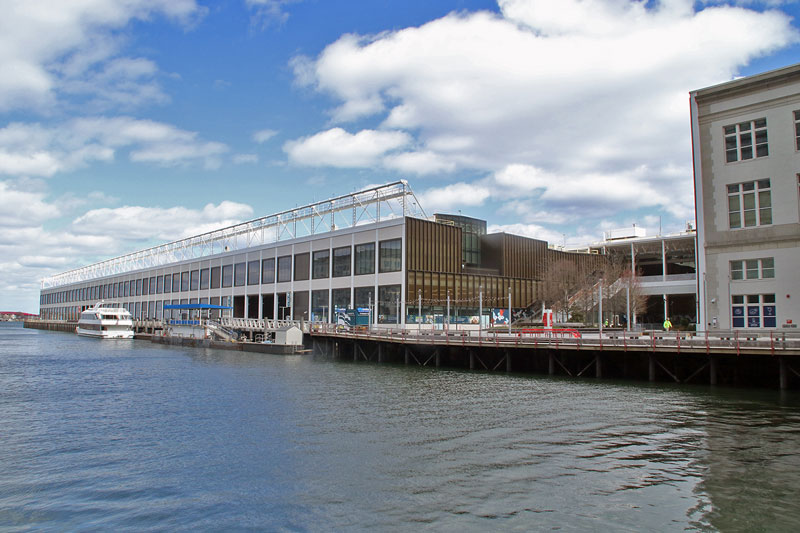
From the Cannistraro facility, the group traveled to Commonwealth Pier in the Seaport District, the historic waterfront property being redeveloped into Fidelity’s future headquarters.
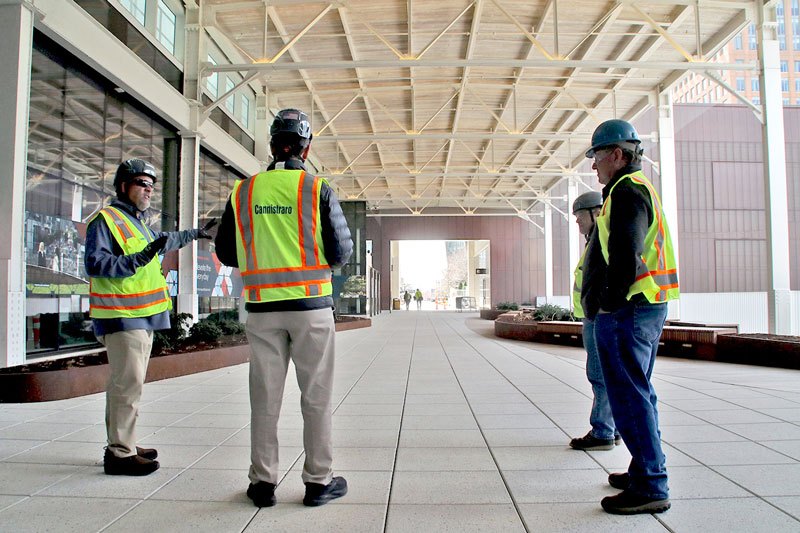
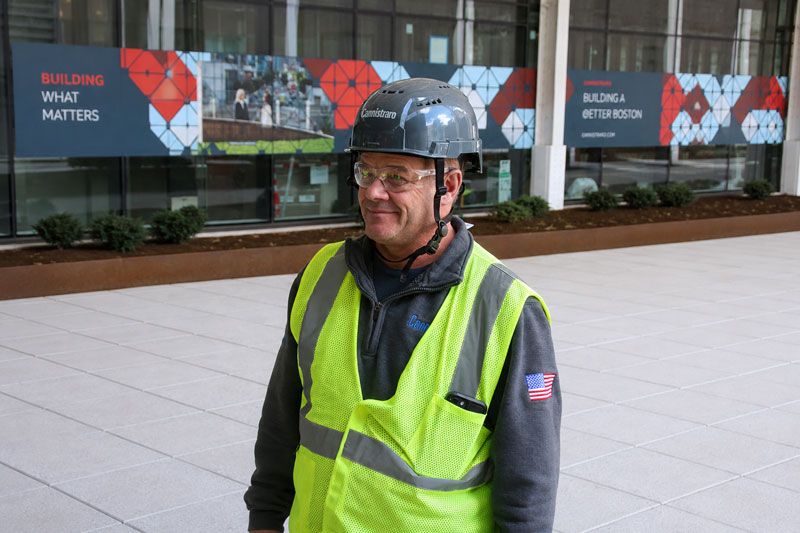
As the tour entered the partially completed building, Ken Reagan noted that the project falls under Massachusetts Port Authority jurisdiction rather than the city of Boston, meaning plumbing inspections are handled by state inspectors rather than the city.
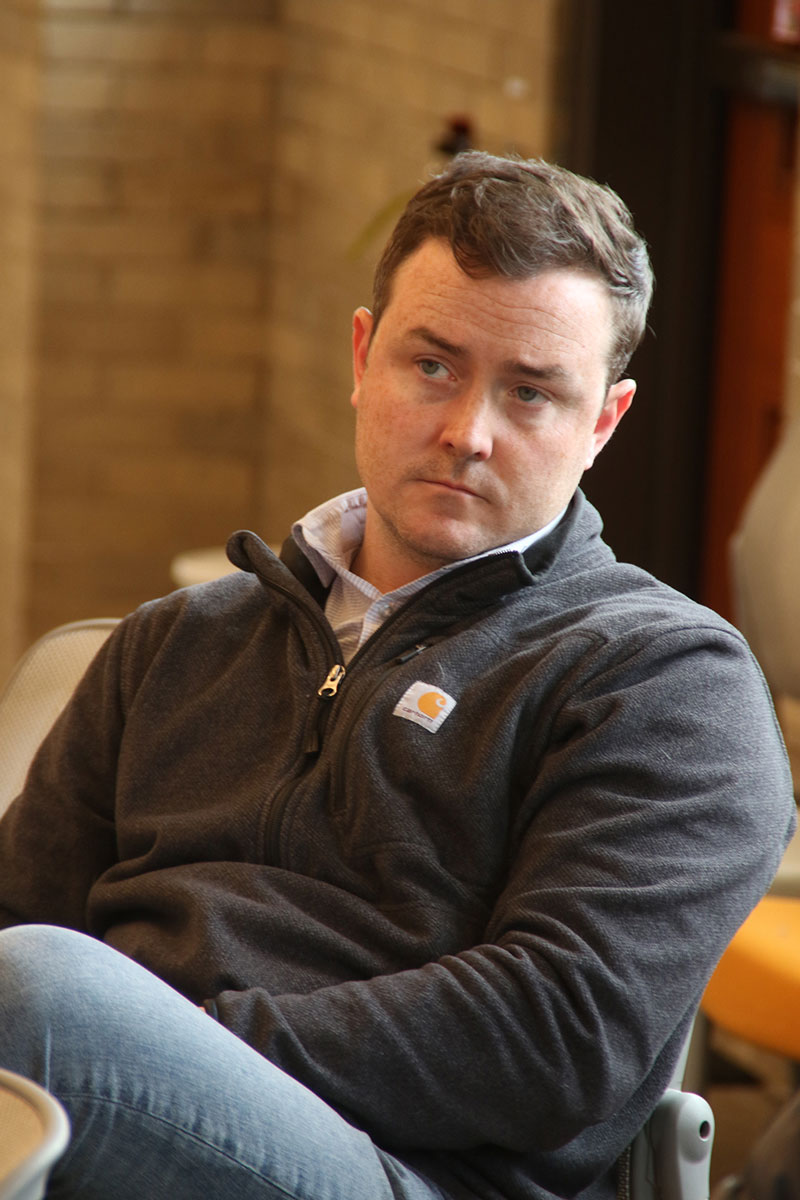
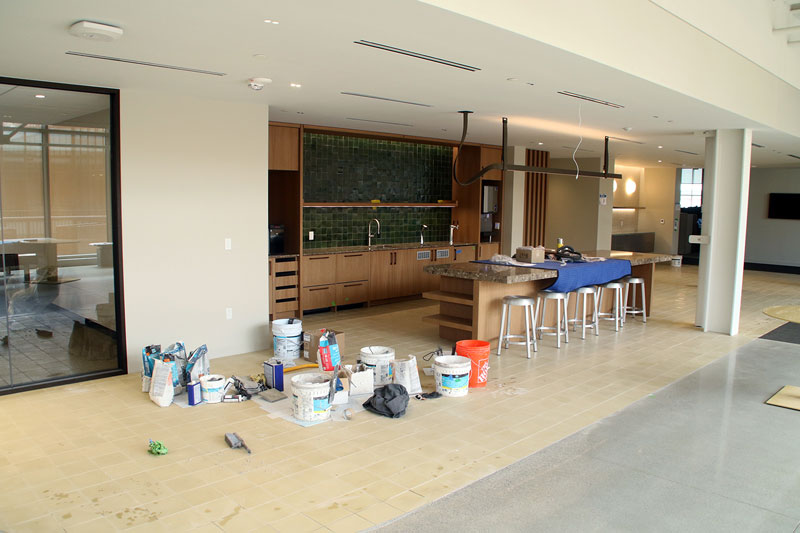
Sean Murphy, plumbing superintendent for J.C. Cannistraro, guided the group through portions of the event space, auditoriums, main kitchen and restroom areas completed as part of the redevelopment.
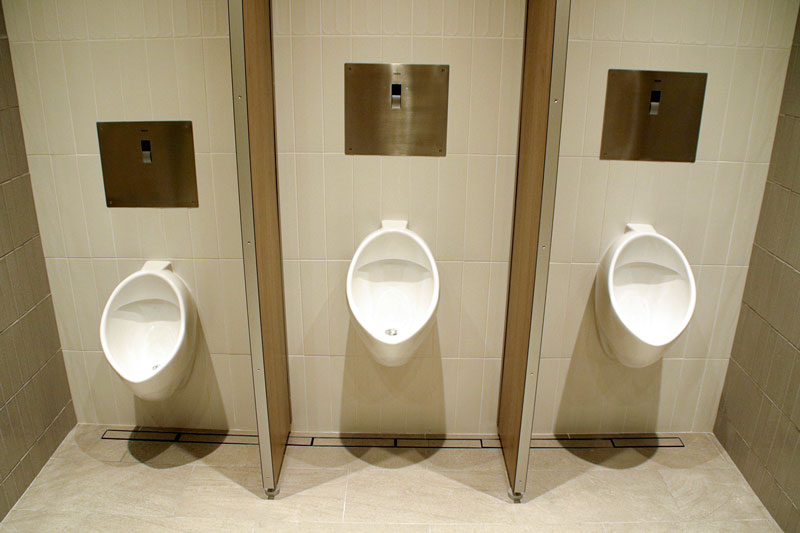
Inside the restroom areas, Murphy pointed out linear floor drains installed behind fixtures throughout portions of the project.
PHOTOS BY GEOFF BILAU
“Normally in Massachusetts you would just need one floor drain per bathroom if there’s urinals or two or more water closets,” Reagan said. “But this particular job, concerns about flooding, about the sense of space and everything, so they added some additional drainage.”
The group also discussed full-height restroom partitions and gender-neutral restroom layouts, which participants said are becoming increasingly common in Massachusetts projects.
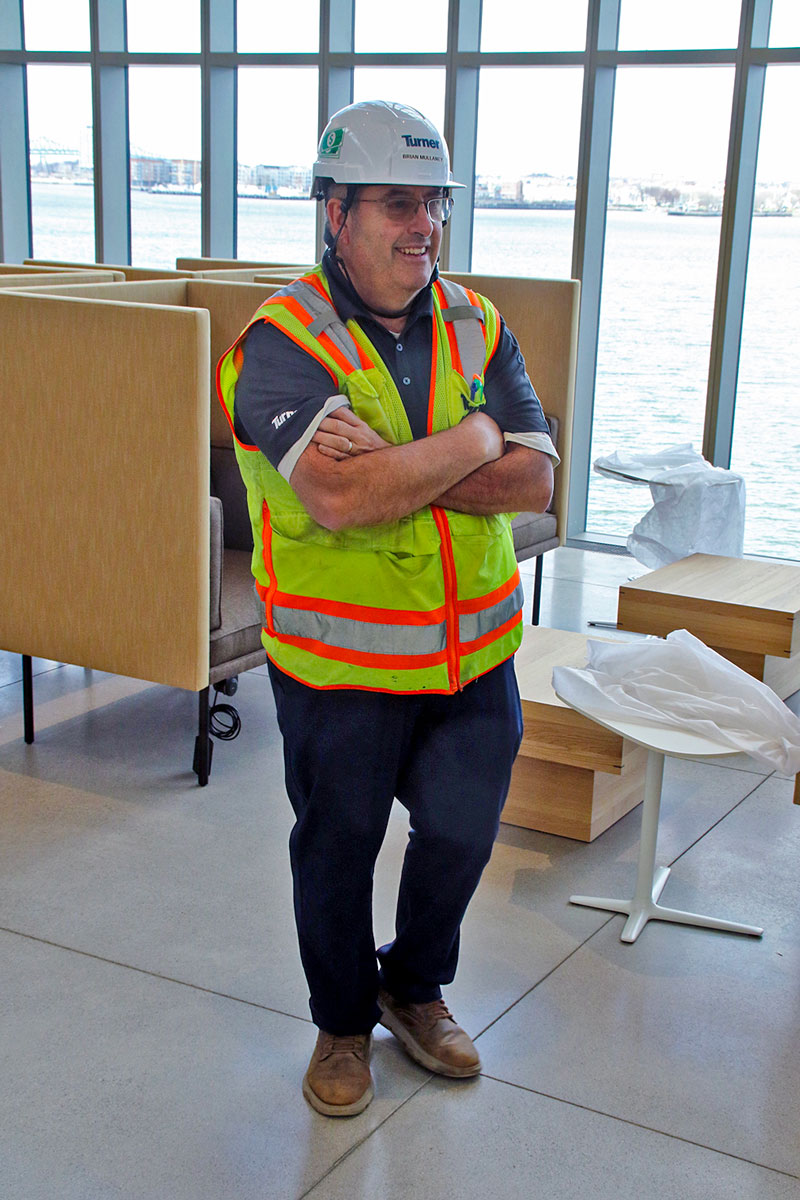
Further into the building, the tour met Project Superintendent Brian Mullaney of Turner Construction, who discussed the long timeline and complexity of the redevelopment project.
“We love old buildings,” Mullaney said. “They need lots of work.”
Mullaney said the current renovation has been in planning and construction for years and described it as the largest renovation the property has undergone.
The discussion shifted to the building’s mechanical systems.
“There’s zero natural gas in the whole entire building,” Reagan said.
Reagan asked Mullaney about the building’s heating systems and whether the project relied primarily on heat pumps.
“Nah, just HVAC systems up on the roof. Cooling towers and VAVs [variable air volume boxes],” Mullaney said.
“But all electric driven,” Reagan replied, which Mullaney confirmed.
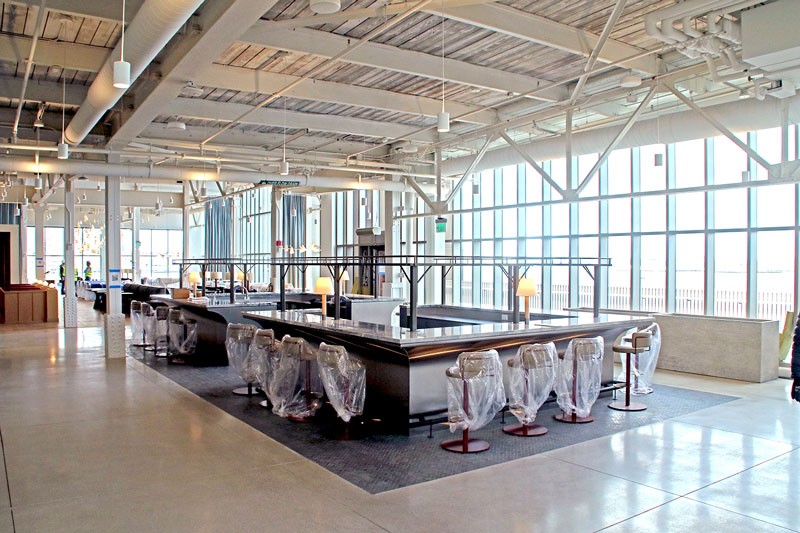
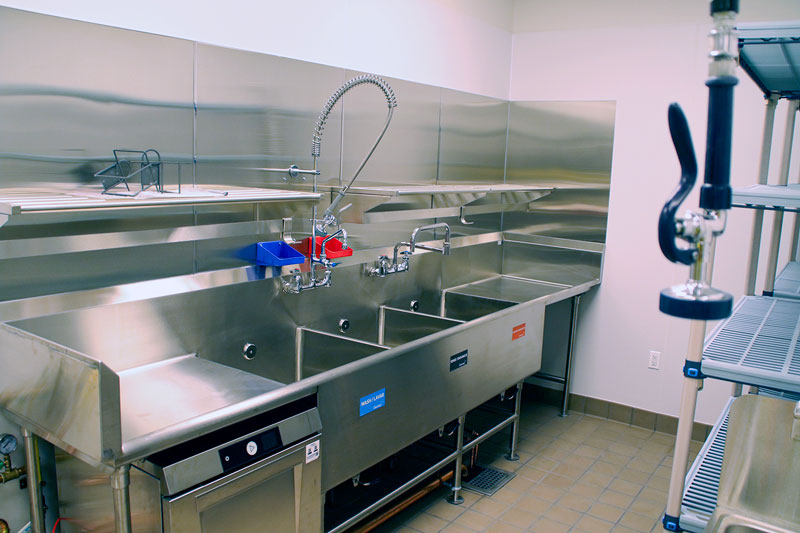
Reagan said the team is seeing more all-electric projects throughout Boston, particularly in large commercial developments.
“We’re seeing a lot more of that, unfortunately for us gas fitters, of course,” Reagan said. Mullaney said planning work on the project dates back to around 2018, when crews began opening columns and evaluating the building’s original wood pile foundations to determine how much additional weight the structure could support.
He said engineers performed stress tests on multiple columns and discovered portions of the structure could not support additional loading without risking settlement.
The building, originally constructed in the early 1900s as part of the waterfront shipping industry, was intentionally pitched away from the harbor to prevent oils and other materials from draining outward into Boston Harbor.
Over time, portions of the structure settled significantly.
“We’ve had like a 6-inch pitch in about 40 feet,” Mullaney said.
To compensate, the redevelopment added raised flooring systems throughout much of the building to create level office space. “Back here, it was almost two feet,” Mullaney said of some floor elevations.
Walking through the building, Mullaney pointed out some of the challenges crews faced during the renovation.
“Nothing’s straight, nothing’s square, nothing’s plumb,” Mullaney said. “If you sight the columns down, you’ll see they’re all in and out by inches.”
Reagan said the Seaport was once difficult to navigate and disconnected from much of downtown Boston, but newer walkways and redevelopment projects are helping integrate the convention center and waterfront more closely with the city.
DeAngelo noted that Logan Airport flight paths have shaped much of the district’s development by limiting building heights throughout the Seaport.
“They had to cap them at a certain height,” DeAngelo said. “So they’re all essentially the same height.”
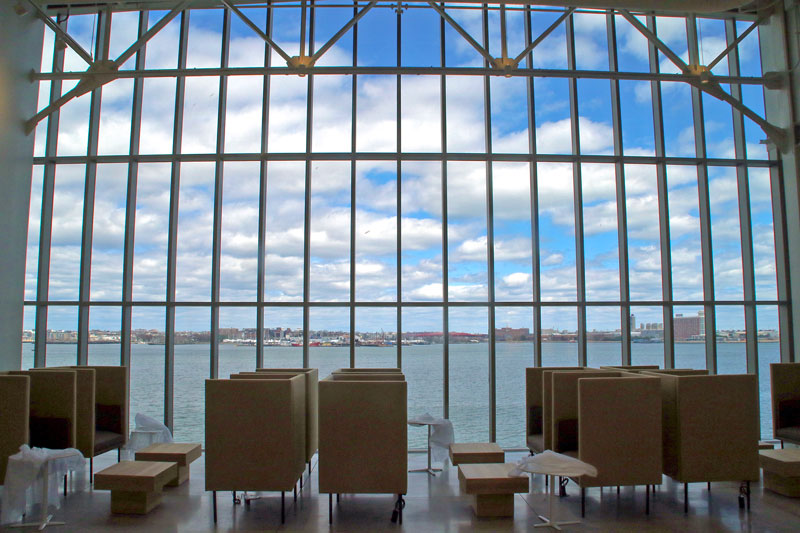
PHOTO BY GEOFF BILAU
Code and Collaboration
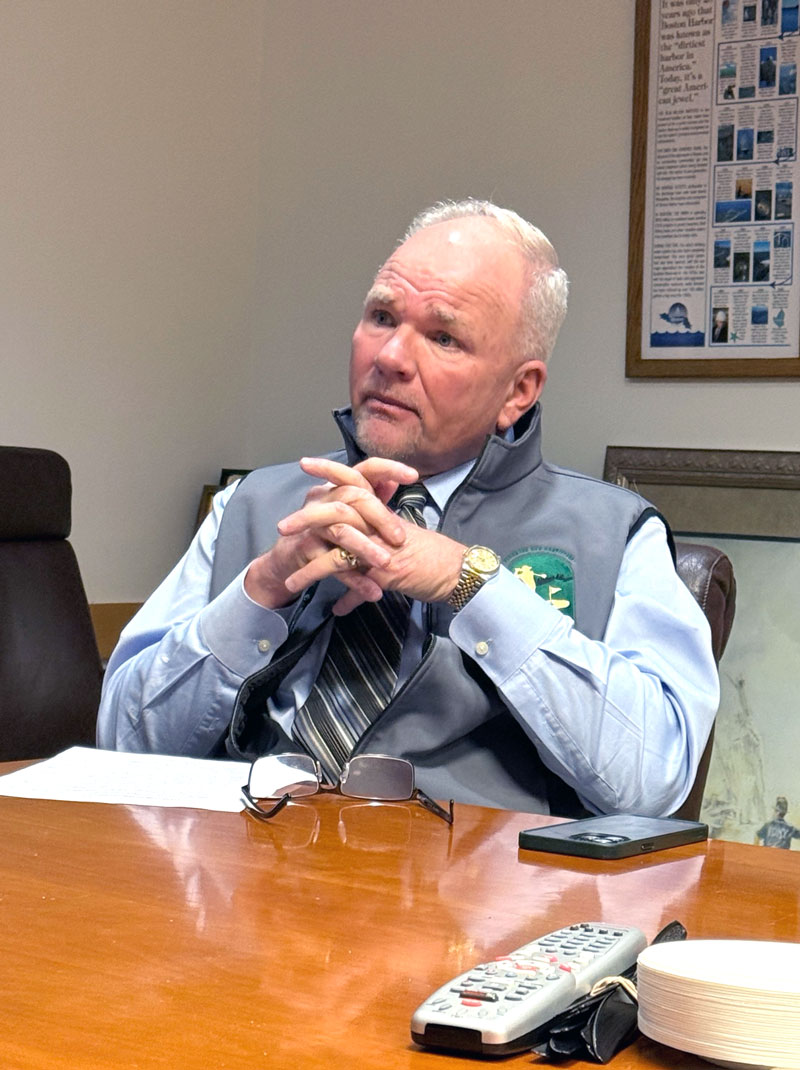
After leaving the Seaport and parting ways with most of the tour group, Peter Kelly and the Official magazine team returned to UA Local 12’s Dorchester training center to meet with Jim Vaughan, business manager and financial secretary-treasurer of UA Local 12.
Vaughan said IAPMO’s longstanding presence in Massachusetts has helped strengthen relationships across the plumbing industry.
“IAPMO is the leader of the industry in Massachusetts,” Vaughan said. “And the reason why they are, I believe, is because of the people you have.”
He said the plumbing industry is changing rapidly as contractors adopt new software and digital systems on large projects, and that IAPMO has helped keep contractors, inspectors and union members informed about technical changes, recalls and code updates affecting the industry.
Vaughan said IAPMO’s local presence is important because practices in Massachusetts can differ from other parts of the country.
“They know how it’s done here, and the way it’s done here might not be done the same way as it is in California or wherever it is,” he said. “But you need to have people involved that have walked the walk. I can’t speak highly enough for the team that you have in Boston.”
Asked about IAPMO’s more than 20 years of continuing education programs for Massachusetts inspectors and licensees, Vaughan said the training has helped create greater consistency across jurisdictions throughout the state.
“I think it’s brought us all together,” he said. “Most people go to the IAPMO training, and really that’s great for the younger plumbers that go from town to town because what Jimmy the plumbing inspector wants here, the guy in the town over is doing the same thing, and that’s what he wants.”
Vaughan said code enforcement remains one of the industry’s most pressing challenges, while acknowledging that it has improved significantly during his career.
“It’s 10 times better than what it has ever been, but we still have some inspectors that don’t enforce as strong as they should,” he said.
Vaughan, who also serves as a part-time inspector in Dover, said inspector recruitment remains a challenge as many longtime inspectors approach retirement age.
PHOTOS BY GEOFF BILAU
“The inspectors have done a great job getting on the same page, but I think when it really comes down to it, a lot of inspectors are underpaid,” he said. “And I think if they made a little bit more money, that might get more people interested.”
Vaughan said many inspectors remain in their positions well past traditional retirement age because some cannot afford to retire.
Beyond enforcement and staffing concerns, Vaughan said plumbing organizations across Massachusetts often come together on code-related issues, even when they disagree on other industry matters.
“When it comes to the plumbing code, and strictly the plumbing code, it’s a win-win for everybody if we’re on the same page,” Vaughan said.
He said groups including PHCC of Massachusetts, the Greater Boston Plumbing Contractors Association and inspector organizations frequently work together on plumbing code issues because all sides ultimately want consistency and strong standards throughout the industry.
Vaughan also said the union has placed greater emphasis on supporting members beyond technical training and workforce development, including mental health awareness and recovery resources for workers in the trades. He said the demands of the industry can weigh heavily on members and union leadership alike, particularly when dealing with addiction, personal struggles and the broader pressures affecting workers and their families.
Vaughan recalled asking UA General President Mark McManus, “Who helps the helper?” during a conversation about the emotional toll that can come with supporting members through difficult situations.
He pointed to growing conversations within the UA around mental health and member well-being, as well as support efforts such as Pipe PALS (Peer Allies for Success), as signs that the industry has become more willing to openly address challenges that previous generations often ignored.
The discussion also turned to technology, water quality systems and gray water reuse.
Vaughan said gray water and rainwater collection systems should become far more common in future construction projects as water supply concerns continue growing across Massachusetts.
“Every flat roof or every building should have some type of collection system where you can flush toilets with it, and you can do laundry,” he said.
Kelly noted that industry groups, including IAPMO, have spent several legislative sessions educating lawmakers about gray water reuse proposals pending in the State House.
Vaughan also pointed to concerns involving unlicensed installation of water filtration and reverse osmosis systems, saying potable water work should remain under the oversight of licensed plumbers.
“Potable water — that’s our thing,” he said.
Asked what makes the Massachusetts plumbing industry strong, Vaughan pointed to the way UA Local 12’s apprenticeship program exceeds state training requirements.
“By the state rules you have to do 110 hours a year,” Vaughan said. “We do 240 a year here. In the state you do a four-year apprenticeship; we do a five-year apprenticeship.”
He said the additional training allows apprentices to graduate certified in medical gas and rigging while also gaining exposure to CAD and GPS systems.
PHCC of Massachusetts
Official magazine later spoke with Wayne Thomas, executive director of PHCC of Massachusetts, about the challenges and priorities shaping the Massachusetts plumbing industry.
The PHCC of Massachusetts is part of the national Plumbing-Heating-Cooling Contractors Association and has four local chapters throughout the state.
Thomas said Massachusetts’ independent plumbing code and standardized continuing education requirements help distinguish the state’s plumbing industry from much of the country.
He said Massachusetts has maintained its own plumbing code since the 1960s, while the state plumbing board requires all approved continuing education providers to teach the same curriculum.
“They’re all learning something that is consistently correct,” Thomas said. “Same thing with the inspectors — and IAPMO does all the inspectors — and they’re all learning the same thing.”
Thomas said the continuing education program has helped create greater consistency across the industry.
“I know one thing is our workforce is much better educated than it was 15 years ago,” Thomas said, adding that portions of the state’s continuing education structure were modeled after a similar program in Texas. Thomas said PHCC works with IAPMO and other industry organizations each year to help develop continuing education curriculum for Massachusetts licensees, and that IAPMO is regularly represented at plumbing board and other industry meetings.
“I’ve got a great relationship with everybody from IAPMO,” Thomas said. “The relationship is very good.”
Kelly pointed to the annual Plumbing Advocacy Day at the Massachusetts State House — which brought together representatives from groups including the PHCC of Massachusetts, IAPMO, the GBPCA and UA Local 12 — as an example of how plumbing organizations across Massachusetts frequently work together on industry and legislative issues.

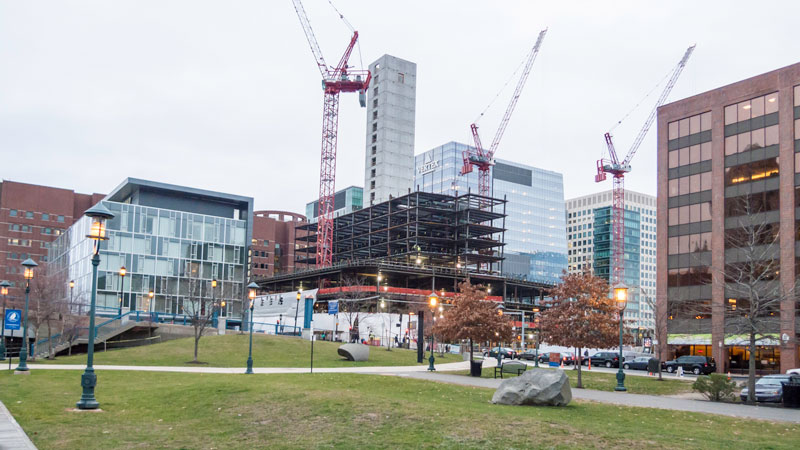
Construction at One Seaport Square viewed from Children’s Wharf along the Harborwalk on Fort Point Channel in South Boston.
GETTY IMAGES
Through his involvement with PHCC National’s Associate Executive Council, Thomas said he regularly speaks with plumbing industry leaders from other states about issues affecting contractors and associations nationwide.
He said many are surprised by the relationship between union and non-union plumbers and gas fitters in Massachusetts.
“To a person, they can’t believe it,” Thomas said. “It’s a working collaborative.”
Thomas acknowledged the relationship was more contentious earlier in his career but said it has improved significantly over time.
“As long as we’re all working toward the same goal, everybody seems to be happy,” Thomas said.
Kelly added that leadership within the organizations has also helped strengthen collaboration across the industry.
Thomas noted that many union signatory contractors are also members of PHCC of Massachusetts, further reinforcing ties between organizations throughout the state.
Thomas also discussed his work with the state Board of Plumbers and Gas Fitters, which he said frequently handles variance requests involving historic buildings.
“Although we don’t want to bend the rules too much, we’re always looking for creative ways to be able to improve the facilities while not compromising the integrity of historical buildings,” he said.
Thomas said electrification — shifting from the use of fossil fuels like natural gas to electricity to power buildings — is the biggest challenge contractors face in Greater Boston and across Massachusetts.
“The restrictions on new gas services, restrictions on existing gas services, adding to them,” he said. “That’s by far and above the most concerning and controversial thing that we’re dealing with right now.”
The discussion also turned to water reuse and gray water systems.
Thomas said contractors are seeing growing interest in water reuse technologies as drought concerns continue across parts of Massachusetts.
“There are no requirements for it right now, and it’s something that I think all contractors know that we need to address at some point,” he said.
Thomas also emphasized the importance of apprenticeship standards and licensing requirements in Massachusetts, saying both play a critical role in maintaining safety and professionalism throughout the industry.
“There’s always efforts to circumvent the licensing requirements,” he said. “We just want to be safe.”
Thomas said allowing unlicensed individuals to work on plumbing systems can compromise public health and safety because plumbing work requires trained professionals who remain continuously educated throughout their careers.
Asked what people outside the industry should understand about plumbing work in Boston, Thomas said the state’s strong regulations and professional standards play a major role in protecting public health.
“We don’t have cases of Legionella that pop up like a lot of other states do,” Thomas said. “We’re well-regulated. We have people that take pride in what they do, and it shows.”
Mike Flenniken
Mike Flenniken is a staff writer, Marketing and Communications, for IAPMO. Prior to joining IAPMO in 2010, Flenniken worked in public relations for a group of Southern California hospitals and as a journalist in writing and editing capacities for various Southern California daily newspapers.
Last modified: July 14, 2026