
July 2, 2026

From the 2024 UPC Illustrated Training Manual, Chapter 7 – SANITARY DRAINAGE
702.3 Continuous Flow. For a continuous flow into a drainage system, such as from a pump, sump ejector, air conditioning equipment, or similar device, 2 fixture units shall be equal to each gallon per minute (gpm) (L/s) of flow.
Continuous flows do not derive from individual plumbing fixtures discharging immediately into the drainage system, and are not subject to the predictability of being on or off as discussed in Section 702.2. Continuous flows will typically have higher discharge rates that most plumbing fixtures. This type of flow, such as from a sewage discharge pump, has a greater load on the system than does an intermittent flow from a plumbing fixture since the pump flows continuous for a longer period of time at a higher discharge flow rates.
The flow rate from the continuously flowing pump or device is assigned two fixture units for each gallon per minute of discharge. This provision was first added to the UPC in 1952 (albeit in another section on Drainage Below Curb), which corresponds with the Plumbing Manual (BMS66) published by the National Bureau of Standards in 1940. The Plumbing Manual (p.15) assigned 50 fixture units to sewage ejector or sump pumps for each 25 gallons per minute (the same as two fixture units per gallon per minute). Pump sizes were typically incremented in discharge flow rates of approximately 25 gpm. Possibly, the following two steps may have been used to derive the 50 fixture units per 25 gpm. First, if 25 gpm was converted to fixture units by dividing 25 by 7.5 (1 fixture unit equal to 7.5 gpm), then the result is 3.3 fixture units. Secondly, if the duration of the pump was contrasted to the duration of a toilet flush, which approximated six seconds, and if the duration of a pump was considered 90 seconds during peak loads, then the duration of the pump is 15 times longer than a toilet flush. The factor of 15 multiplied to the 3.3 fixture units renders a total of 49.5 fixture units, or 50 fixture units rounded. So for an ejector pump with a discharge capacity of 75 gpm, divide 75 by 7.5 and multiply by the factor of 15. The result is 150 fixture units, or two fixture units per gallon per minute. The installation of sump pumps is discussed further in Section 710.0.
From the 2024 UMC Illustrated Training Manual, Chapter 3 – GENERAL REGULATIONS
304.3.2 Permanent Lighting. Permanent lighting shall be provided at the roof access. The switch for such lighting shall be located inside the building near the access means leading to the roof. [NFPA 54:9.4.3.4]
Lighting should be provided at the interior roof access opening, with a switch located inside the building near the access opening (see Figure 304.3.1.1a). Please note that, unlike other codes, this code does not require a light near the equipment on the roof, but rather, just means to illuminate the path through the roof access opening.
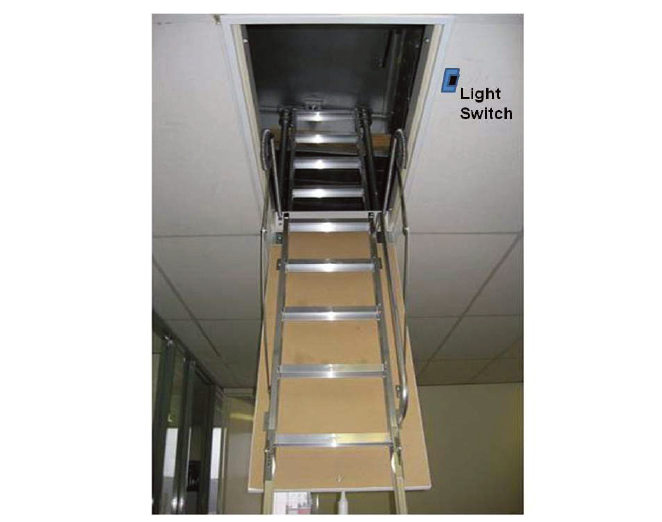
INTERIOR FOLDAWAY LADDER
(This is not to be considered the official position of IAPMO, nor is it an official interpretation of the Codes.)

IAPMO
IAPMO develops and publishes the Uniform Plumbing Code®,the most widely recognized code of practice used by the plumbing industry worldwide; Uniform Mechanical Code®; Uniform Swimming Pool, Spa and Hot Tub Code®; and Uniform Solar Energy, Hydronics and Geothermal Code™ — the only plumbing, mechanical, solar energy and swimming pool codes designated by ANSI as American National Standards — and the Water Efficiency Standard (WE-Stand)™. IAPMO works with government, contractors, labor force, and manufacturers to produce product standards, technical manuals, personnel certification/educational programs and additional resources in order to meet the ever-evolving demands of the industry in protecting public health and safety.
Last modified: July 1, 2026