
June 4, 2026
From the 2024 UPC Illustrated Training Manual, Chapter 6 – WATER SUPPLY AND DISTRIBUTION
609.2 Trenches. Water pipes shall not be run or laid in the same trench as building sewer or drainage piping constructed of clay or materials that are not approved for use within a building unless both of the following conditions are met:
(1) The bottom of the water pipe shall be not less than 12 inches (305 mm) above the top of the sewer or drain line.
(2) The water pipe shall be placed on a solid shelf excavated at one side of the common trench with a clear horizontal distance of not less than 12 inches (305 mm) from the sewer or drain line.
Water pipes crossing sewer or drainage piping constructed of clay or materials that are not approved for use within a building shall be laid not less than 12 inches (305 mm) above the sewer or drainpipe.
For a variety of reasons, either water or drainage piping may develop leaks over a period of time. The fill material (backfill) around these pipes will become saturated when a leak occurs. Saturated soil becomes a bridge for bacterial travel between pipes. When one of these pipes is carrying potable water and the other is transporting waste water, there is a considerable threat to the potable water system. Therefore, it is essential that potable water and waste piping not be allowed to share a common trench unless the building sewer is constructed of materials approved for use within the building.
The requirement of a “solid shelf” that is 12 inches above and 12 inches horizontal from the top of a sewer pipe is to provide an independent “trough” for each pipe (see Figure 609.2). A failure in the sewer piping will eventually result in saturation and settlement of the fill material above the sewer. However, because the water piping is supported on an independent trench base and is off to one side of the common trench, it will be unaffected by this event.
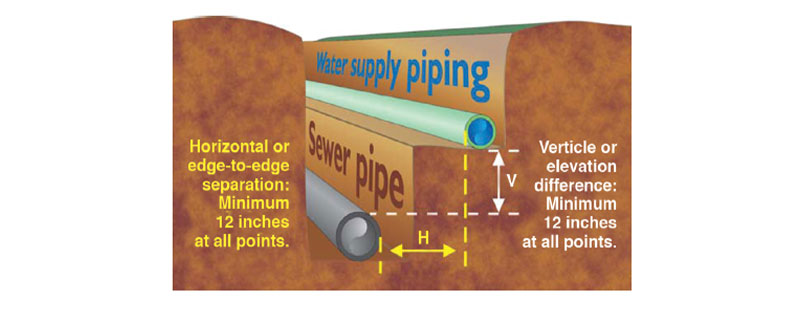
WATER AND SEWER LINE SEPARATION
From the 2024 UMC Illustrated Training Manual, Chapter 3 – GENERAL REGULATIONS
316.6 Steel Nail Plates. Plastic piping or tubing, copper or copper alloy piping or tubing, and ducts penetrating framing members to within 1 inch (25.4 mm) of the exposed framing shall be protected by steel nail plates not less than No. 18 gauge (0.0478 inches) (1.2141 mm) in thickness. The steel nail plate shall extend along the framing member not less than 1 1/2 inches (38 mm) beyond the outside diameter of the pipe or tubing. Fuel gas piping shall be protected in accordance with Section 1310.4.3.
The protection of ducts or piping in the interior of walls is of utmost importance. The penetration of plastic and copper pipe by nails, screws or staples is very common. The methods provided here will ensure the pipe is not punctured either during construction or later by the owner of the building.
Section 1310.4.3, Tubing in Partitions, discusses the requirements for fuel gas piping protection. These requirements will be more stringent because of the volatility of the contents of the pipe. The pipe manufacturer’s installation requirements should also be taken into consideration. These requirements may be even more stringent and, if so, should therefore be followed instead (see Figure 316.6).
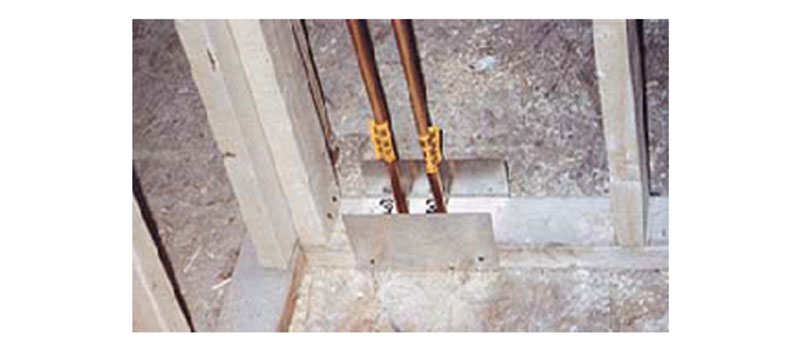
USE OF NAIL PLATES
(This is not to be considered the official position of IAPMO, nor is it an official interpretation of the Codes.)

IAPMO
IAPMO develops and publishes the Uniform Plumbing Code®,the most widely recognized code of practice used by the plumbing industry worldwide; Uniform Mechanical Code®; Uniform Swimming Pool, Spa and Hot Tub Code®; and Uniform Solar Energy, Hydronics and Geothermal Code™ — the only plumbing, mechanical, solar energy and swimming pool codes designated by ANSI as American National Standards — and the Water Efficiency Standard (WE-Stand)™. IAPMO works with government, contractors, labor force, and manufacturers to produce product standards, technical manuals, personnel certification/educational programs and additional resources in order to meet the ever-evolving demands of the industry in protecting public health and safety.
Last modified: June 4, 2026