
April 30, 2026
From the 2024 UPC Illustrated Training Manual, Chapter 7, SANITARY DRAINAGE
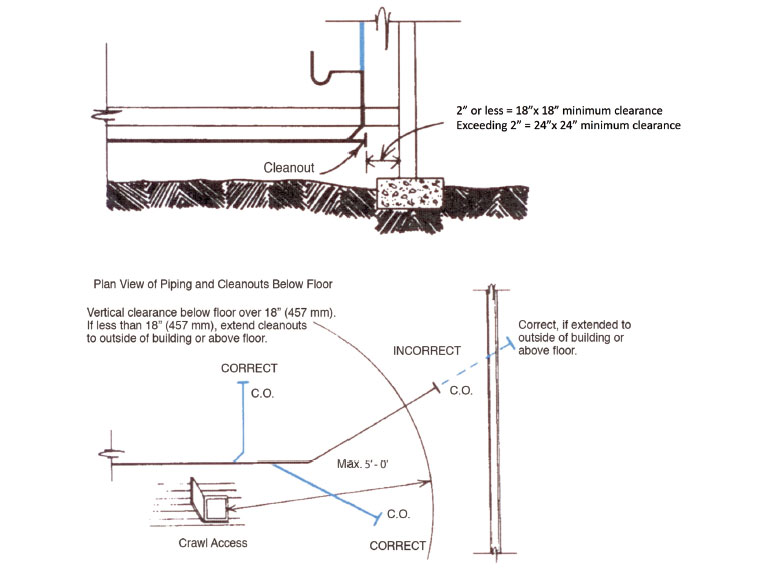
707.9 Clearance. Each cleanout in piping 2 inches (50 mm) or less in size shall be so installed that there is a clearance of not less than 18 inches (457 mm) by 18 inches (457 mm) in front of the cleanout. Cleanouts in piping exceeding 2 inches (50 mm) shall have a clearance of not less than 24 inches (610 mm) by 24 inches (610 mm) in front of the cleanout. Cleanouts in under-floor piping shall be extended to or above the finished floor or shall be extended outside the building where there is less than 18 inches (457 mm) vertical overall, allowing for obstructions such as ducts, beams, and piping, and 30 inches of (762 mm) horizontal clearance from the means of access to such cleanout. No under-floor cleanout shall be located exceeding 5 feet (1524 mm) from an access door, trap door, or crawl hole.
For practical reasons, a cleanout shall have sufficient clear space in front of the cleanout or around it so that it can be accessed to serve the purpose for which it is intended. The above clearances are for the benefit of the service plumber. They allow enough room for a repair to be completed without too much disruption to the occupants in the building and so the job can be done quickly and efficiently (see Figure 707.9).
CLEANOUT ACCESS
From the 2024 UMC Illustrated Training Manual, Chapter 8, CHIMNEYS AND VENTS
802.3.4 Ventilating Hoods and Exhaust Systems. Where automatically operated appliances, other than food service appliances, are vented through a ventilating hood or exhaust system equipped with a damper or with a power means of exhaust, provisions shall be made to allow the flow of gas to the main burners only when the damper is open to a position to properly vent the appliance and when the power means of exhaust is in operation. [NFPA 54:12.4.4.1]
This is a safe, alternative method for venting of gas utilization equipment in commercial applications. For example, in restaurant kitchens a booster water heater is used to provide very hot water for sanitation. In this application, the booster water heater is operated only while the restaurant kitchen is in operation, and the range hood is used to vent both the range and the water heater.
Range hoods are covered under this code, which requires an interlock that operates when the airflow falls below a predetermined value. This circuit can be interlocked with the main gas valve of the water heater (or other gas appliance vented via the range hood) to prevent gas from flowing to the main burners unless a minimum airflow is achieved in the vent system.
(This is not to be considered the official position of IAPMO, nor is it an official interpretation of the Codes.)
IAPMO
IAPMO develops and publishes the Uniform Plumbing Code®,the most widely recognized code of practice used by the plumbing industry worldwide; Uniform Mechanical Code®; Uniform Swimming Pool, Spa and Hot Tub Code®; and Uniform Solar Energy, Hydronics and Geothermal Code™ — the only plumbing, mechanical, solar energy and swimming pool codes designated by ANSI as American National Standards — and the Water Efficiency Standard (WE-Stand)™. IAPMO works with government, contractors, labor force, and manufacturers to produce product standards, technical manuals, personnel certification/educational programs and additional resources in order to meet the ever-evolving demands of the industry in protecting public health and safety.
Last modified: April 29, 2026