
April 23, 2026

From the 2024 UPC Illustrated Training Manual, Chapter 11, STORM DRAINAGE
1101.12.2 Secondary Drainage. Secondary (emergency) roof drainage shall be provided by one of the methods specified in Section 1101.12.2.1 or Section 1101.12.2.2.
To ensure that rainwater accumulation on a roof is drained away, two independent systems of roof drainage are required. They are the primary roof drainage system and the secondary roof drainage system, commonly referred to as an “overflow system.” The primary system consists of roof drains, piping serving those drains, and the discharge method used. The discharge method may be surface or gravity drainage, or pumped drainage. The secondary system ensures that if the primary system or primary drains are plugged or overloaded, the secondary system will handle the rainwater and drain it away, protecting the building and its occupants from harm (see Figure 1101.12.2).
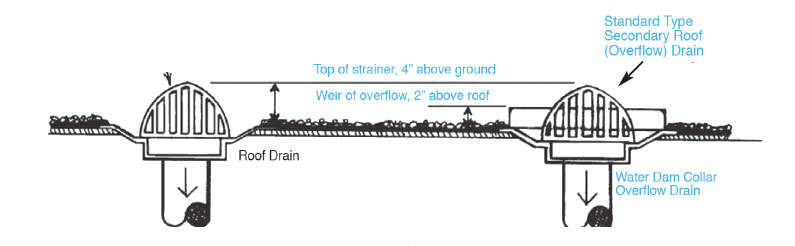
PRIMARY AND SECONDARY ROOF DRAINS – SECONDARY DRAIN WEIR 2 INCH ABOVE PRIMARY – STRAINER 4 INCH ABOVE THE ROOF
The secondary roof drainage system can be of two methods – roof scuppers, open sides of parapet walls, or secondary roof drains. The secondary roof drains can be of two types – roof drains with an independent piping system or roof drains that combine with the primary roof drainage piping, which will require an increase in piping size.
Once the required rainfall data has been determined, the primary and secondary roof drainage system must be sized in accordance with Section 1103.0 using Table 1103.1 (vertical drains and pipe), Table 1103.2 (horizontal drain and pipe) and Table 1103.3 (gutters).
From the 2024 UMC Illustrated Training Manual, Chapter 13, FUEL GAS PIPING
1310.1.1 Cover Requirements. Underground piping systems shall be installed with a minimum of 12 inches (305 mm) of cover. The minimum cover shall be increased to 18 inches (457 mm) if external damage to the pipe or tubing from external forces is likely to result. Where a minimum of 12 inches (305 mm) of cover cannot be provided, the piping shall be installed in conduit. [NFPA 54:7.1.2.1 – 7.1.2.1(B)]
This section recognizes the possible hazard from the pipe being in contact with, or in close proximity to, other underground structures. Such contact can be a hazard and can cause harm to the pipe during backfilling or later, when settlement of the structure(s) occurs. The intent of all the coverage for underground piping is to provide protection for the installed piping from corrosion or physical damage.
Protection from heavy vehicle loads may require deeper burial at a depth of 18 inches or more. An alternative is the use of a casing for the pipe carrying the gas. Deeper burial applies to cultivated areas, with depth-of-cover requirements depending on the anticipated risk, which can vary from hand garden tools to tillage equipment pulled by large tractors. Gas companies with distribution pipes in the area are a good resource to consult when questions about burial depth of piping are raised.
Damage to pipes is not limited to plastic pipe. Copper tubing is severed easily with a shovel, and digging tools can damage the coating on steel pipe, leading to corrosion. Digging with powered digging equipment, such as a backhoe, can also damage steel pipe.
There are two ways to protect the pipe from physical damage. One is to protect the pipe from damage caused by digging, so the protection from digging tools must be of sufficient strength to protect the pipe. Such protection can be provided by installing the gas pipe inside a larger pipe, which becomes a shield, or by locating a protective material, such as a steel plate with corrosion protection, above the pipe. In most cases, the pipe is buried at a sufficient depth so that protective devices are not needed.
The second means is to provide excavators with an indicator that a pipe is buried below. Many gas utilities use a “terra tape” (a yellow plastic tape printed with a warning that gas pipe is buried below) placed a few inches above the pipe to warn future diggers that a gas pipe is buried below; the tape is an indicator and not a protective device (see Figure 1310.1.1).
If protective devices are needed, they must be of sufficient strength to protect the pipe and be made of a material that will not corrode over time. Plastic pipe or PVC is often used as a protective material. Split along its length, plastic pipe or PVC provides the necessary strength and does not corrode underground.
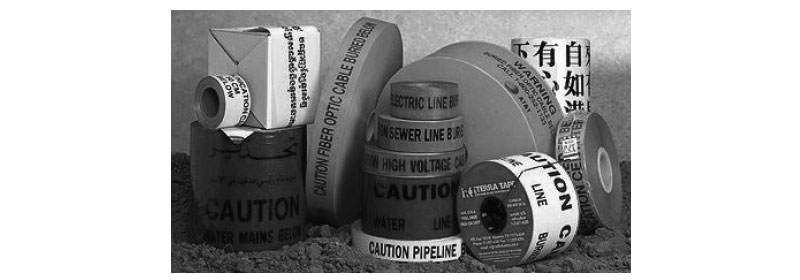
TERRA TAPE
(This is not to be considered the official position of IAPMO, nor is it an official interpretation of the Codes.)

IAPMO
IAPMO develops and publishes the Uniform Plumbing Code®,the most widely recognized code of practice used by the plumbing industry worldwide; Uniform Mechanical Code®; Uniform Swimming Pool, Spa and Hot Tub Code®; and Uniform Solar Energy, Hydronics and Geothermal Code™ — the only plumbing, mechanical, solar energy and swimming pool codes designated by ANSI as American National Standards — and the Water Efficiency Standard (WE-Stand)™. IAPMO works with government, contractors, labor force, and manufacturers to produce product standards, technical manuals, personnel certification/educational programs and additional resources in order to meet the ever-evolving demands of the industry in protecting public health and safety.
Last modified: April 23, 2026