‘Why should the government and private sector come together to provide improved access to clean drinking water?’
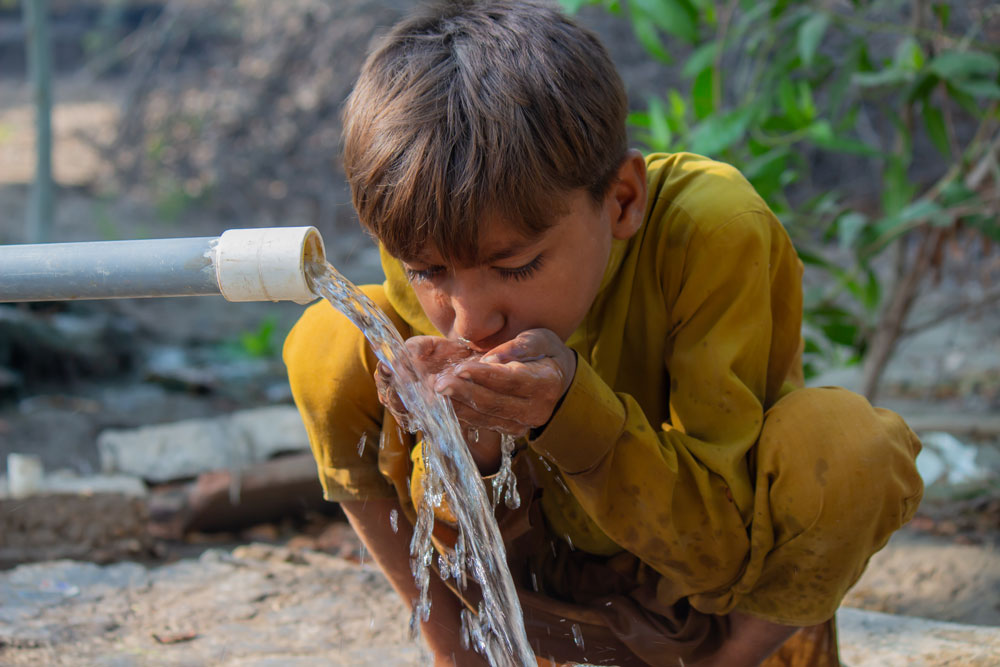

Saba Ahmed
CALVIN UNIVERSITY, GRAND RAPIDS, MICHIGAN
FIRST PLACE 2025 IWSH SCHOLARSHIP ESSAY COMPETITION
Imagine yourself turning on your tap and only murky water greets you, a mixture of rust and doubt. For families in Jackson, Mississippi, that was reality when their aging pipes failed in 2022. In Lagos, Nigeria, mothers pay street vendors ten times the going rate for water that still makes them sick. At home in Islamabad, Pakistan, I learn to store jugs of water whenever the power goes out, knowing the pumps will fall silent for hours or even days. Those outages remind me that clean water is not guaranteed; it is a fragile promise that no single institution can keep on its own.
The Limits of Going It Alone
Governments bear the legal duty to provide safe water, yet many lack the funds or flexibility to meet today’s challenges. The American Water Works Association estimates that repairing America’s crumbling water systems would cost a trillion dollars over the next 25 years, more than the entire federal education budget. Similar funding gaps exist in countries from India to Brazil to South Africa. Private companies on their own have developed extraordinary technologies such as portable water purifiers, solar-powered kiosks, and smart leak detectors. Without public backing, these breakthroughs often remain pilot projects that never scale beyond wealthier neighborhoods.
Cincinnati showed how to bridge that divide. Faced with lead tainted pipes, city officials refused to wait for distant aid. They partnered with Mueller Water Products to deploy sensors that mapped every failing pipe. By triaging their repairs, they cut replacement time by two-thirds and protected children from harmful lead levels. That nimble response could not have happened without local government authority working hand in hand with private expertise.
Global Partnerships in Action
Partnerships are transforming lives worldwide. In Nairobi’s Kibera slum, one of Africa’s largest informal settlements, the government water utility teamed up with Sanivation, a social enterprise, to install bright blue kiosks powered by solar energy. Residents pay by mobile money, and those payments fund water projects in local schools. Since 2021, this system has delivered more than four million liters of clean water while keeping money circulating in the community.
In Vietnam’s Mekong Delta, climate change has made freshwater scarce. Dutch firm Hydraloop worked with village leaders to install floating treatment pods that turn river water into drinking water without expensive infrastructure. Local women maintain the units and earn a living as they protect their families. This project proves that private innovation paired with community engagement can solve even the most daunting environmental challenges.
Training the Next Generation of Water Heroes
A shortage of skilled technicians threatens water security everywhere. In Appalachia, aging pipes and abandoned mines have contaminated wells for decades. A program called WaterStep partnered with the Department of Veterans Affairs and plumbing manufacturers to offer a two week crash course turning veterans into certified water technicians. More than 300 veterans now work restoring rural water systems, bringing jobs and clean water to communities long left behind.
In Brazil’s favelas, the government struggled to maintain complex distribution networks. Working with a local plumbing supplier, they created neighborhood brigades of trained residents who handle basic repairs and spot problems early. As a result, waterborne illnesses in those communities have fallen by nearly half. These brigades are not stopgap fixes; they are durable local assets that empower residents to care for their infrastructure.
Overcoming Barriers to Collaboration
Despite clear benefits, barriers remain. Critics sometimes fear that private involvement will erode public control over a vital resource. Models such as the Paris Water Pact show a middle path. Governments retain ownership of pipes and reservoirs while private contractors compete to meet performance targets under independent review. That structure protects the public interest while tapping business efficiency.
Financing gaps also pose a challenge. California’s water bonds raised more than one hundred million dollars last year, allowing rural towns to replace lead service lines without raising local taxes. Blended finance, mixing public grants, private loans, and pay for performance agreements, has funded microloan programs that helped 43 million families install household water connections across Africa and Asia. The United Nations’ Water Innovation Engine shares patents royalty-free with developing nations, deploying more than eight hundred clean water technologies while creating fifteen thousand local tech jobs (UN Water Innovation Engine 21).
The Ripple Effects of Clean Water
Access to safe water transforms every aspect of life. When Ontario’s Lunaapeew community finally ended a quarter century of boil advisories, teen suicide rates fell by 75 percent. Mothers reclaimed hours once spent hauling buckets. School attendance rose. Economists calculate that every dollar invested in water and sanitation returns more than four dollars in economic growth. Women and girls in rural India gained time for school and work, resulting in a 22 percent increase in girls’ school attendance once taps ran clean.
A Call to Urgent Action
This crisis demands urgency. Every day we delay, a thousand children die from preventable waterborne diseases. No more half measures or costly delays. Governments must set clear standards, streamline regulations, and offer tax incentives for water technology research. Businesses must commit to underserved regions, share their innovations, and train local operators. Communities must insist on co-design, ensuring every new pipeline or kiosk reflects their needs and culture.
Conclusion
Clean water is a human right, but it will only become a reality when public purpose unites with private drive. Picture a future where turning on your tap is never a gamble and every child in every village drinks without fear. That future lies within our grasp if we choose to work together. With one sensor mapped, one kiosk installed, and one technician trained at a time, we can keep the promise of clean water for all. As someone who deals with daily outages and stores water because my city pumps stop whenever the power fails, I know this struggle firsthand, and it motivates me to call for the partnerships we so desperately need.
IAPMO
IAPMO develops and publishes the Uniform Plumbing Code®,the most widely recognized code of practice used by the plumbing industry worldwide; Uniform Mechanical Code®; Uniform Swimming Pool, Spa and Hot Tub Code®; and Uniform Solar Energy, Hydronics and Geothermal Code™ — the only plumbing, mechanical, solar energy and swimming pool codes designated by ANSI as American National Standards — and the Water Efficiency Standard (WE-Stand)™. IAPMO works with government, contractors, labor force, and manufacturers to produce product standards, technical manuals, personnel certification/educational programs and additional resources in order to meet the ever-evolving demands of the industry in protecting public health and safety.
Last modified: February 19, 2026